
Independent assurance cannot be delivered by the party that owns the work, controls the evidence or benefits from the conclusion. Enigma sits on the client’s side of the table.
Key judgement
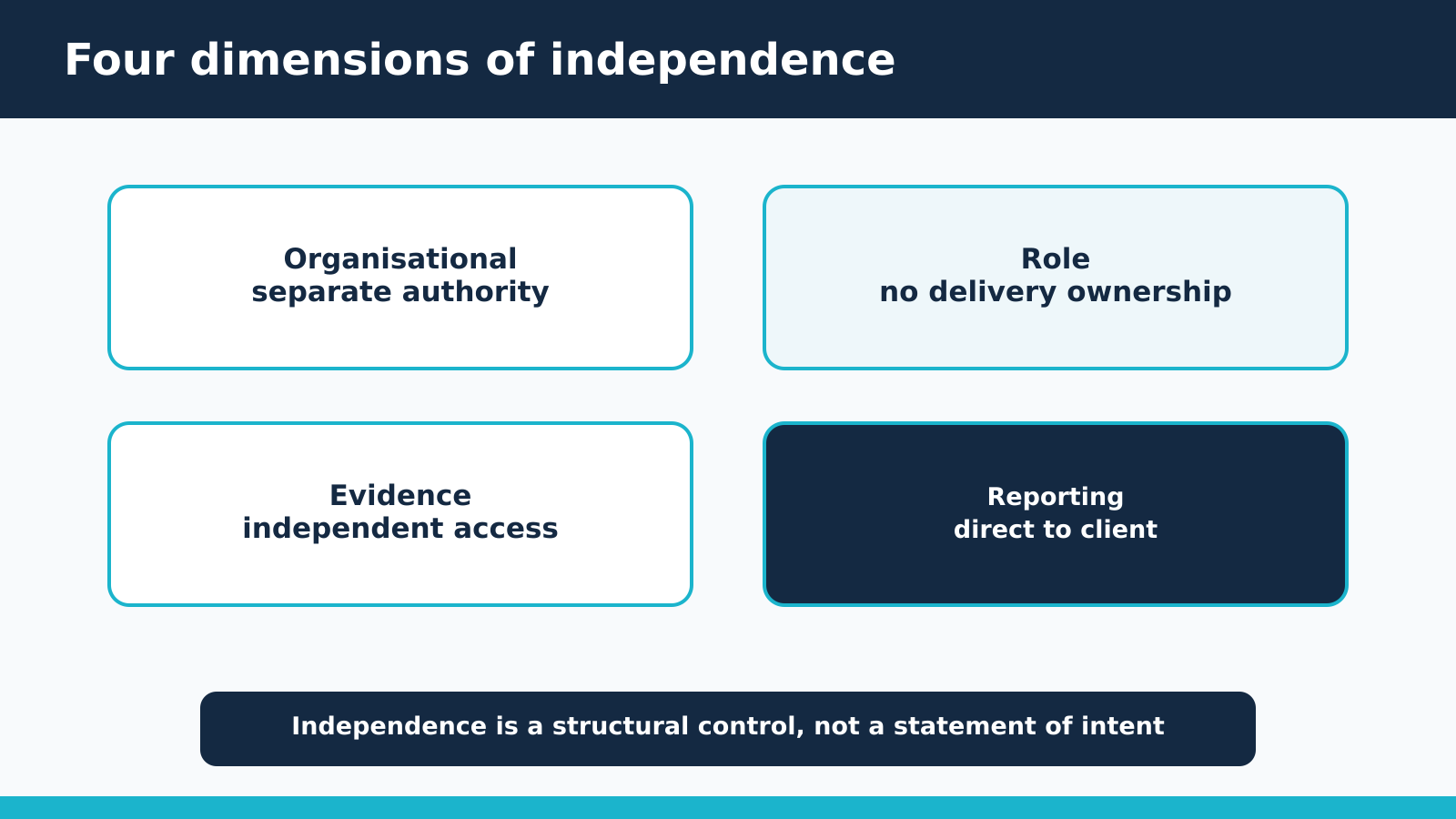
The supplier owns delivery. The client retains accountability. No practitioner may independently assure delivery that they directly own.
Why independence matters
Delivery suppliers can and should perform quality assurance over their own work. Programme managers should challenge plans and internal audit may review organisational controls. Those functions are valuable, but they do not remove the need for client-side assurance when the client must rely on supplier claims to make a material decision.
Independence is not a claim of neutrality or infallibility. It is a controlled position that protects evidence access, judgement and reporting from interests that could distort the opinion.
Four dimensions of independence
| Dimension | Required position |
|---|---|
| Structural | The reviewer reports to the accountable client or its authorised governance, not to the delivery line being assured. |
| Financial | Fees and continuation are not conditional on a favourable rating, finding class or approval outcome. |
| Operational | The reviewer does not own the deliverable, corrective action or control being independently assessed. |
| Cognitive | Prior assumptions, close relationships and repeated reliance on the same management explanation are actively challenged. |
Unacceptable arrangements
| Arrangement | Why it compromises assurance | Required response |
|---|---|---|
| A practitioner assures work they directly designed or delivered | The reviewer is judging their own decisions and evidence. | Separate delivery advice from assurance and appoint an independent reviewer. |
| The supplier chooses which evidence and people are available | The subject of the review controls the basis of the opinion. | Use client-authorised direct access and record any restriction. |
| The required conclusion is agreed before fieldwork | The review becomes confirmation rather than assurance. | Reframe the mandate to allow all evidence-supported outcomes. |
| Payment or renewal depends on a favourable opinion | Financial interest can influence classification and reporting. | Remove the incentive or decline the assurance role. |
| A material prior interest is not disclosed | The client cannot judge the credibility of the opinion. | Declare the conflict, apply safeguards or withdraw. |
| The reviewer owns closure of their own remedial work | Action delivery and independent verification are combined. | Use a separate verifier and preserve the audit trail. |
Required safeguards
- Record an independence and conflict declaration at the start of the mandate and update it when circumstances change.
- Maintain a direct reporting route to the client decision maker, including urgent escalation outside normal supplier governance.
- Give the reviewer access to relevant people, source evidence and governance records without supplier filtering.
- Separate advisory delivery, management action and independent verification responsibilities.
- Use peer review, role rotation or an alternative reviewer where prior involvement could reasonably affect judgement.
- Keep a traceable record of evidence, limitations, factual corrections and changes to conclusions.
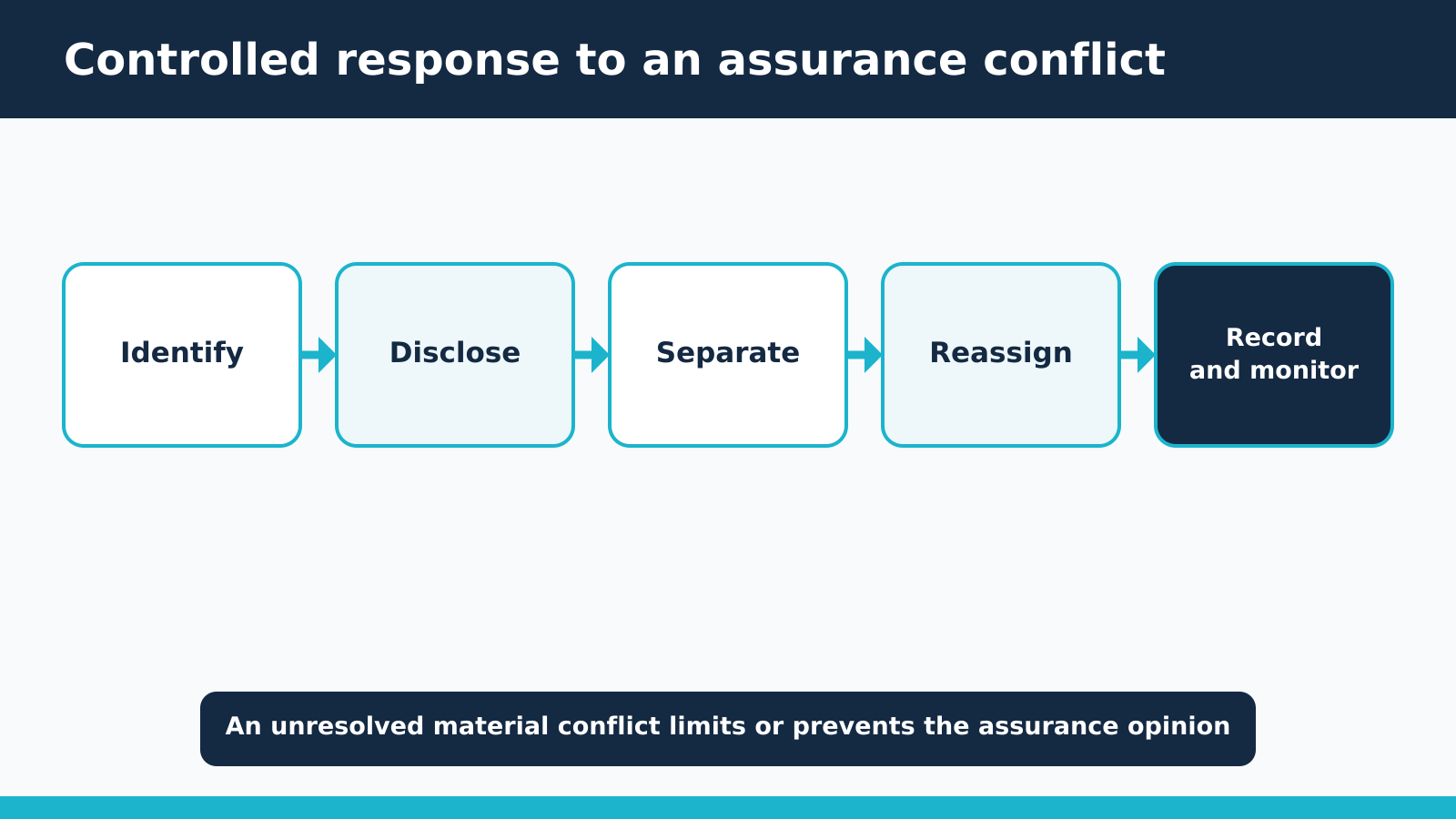
- State any unresolved restriction or conflict in the assurance opinion.
Role boundary
| Party | Owns | Does not transfer |
|---|---|---|
| Delivery supplier | Delivery plan, solution, quality controls, evidence production, remediation and contractual obligations. | Accountability for delivery performance. |
| Client | Objectives, investment decisions, risk acceptance, supplier challenge and accountable governance. | Accountability for relying on the supplier. |
| Independent assurer | Evidence testing, assurance judgement, findings, limitations and closure verification within mandate. | Delivery ownership or the client’s decision authority. |
Applying the standard proportionately
Central Government
The assurance route should protect the SRO and programme board’s access to evidence across strategic suppliers. Conflicts, role history and restrictions should be explicit where opinions support major approvals or public accountability.
Local Government
A council may not need a permanent assurance function. Independence can be established through a time-bound mandate, direct reporting to the accountable authority and clear separation from the implementation supplier, while avoiding unnecessary governance overhead.
SMEs
An SME can obtain proportionate challenge without building a full internal team. The key is that the reviewer is appointed by the client, can access source evidence and is not rewarded for endorsing the supplier’s position.
Conflict response
1. Declare
2. Assess materiality
3. Apply safeguard
4. Obtain client acceptance
5. Reassess throughout
Some prior knowledge can improve efficiency and does not automatically prevent assurance. The test is whether a reasonable client could rely on the judgement after understanding the interest and safeguards. Where the conflict cannot be reduced to an acceptable level, Enigma should not provide the independent opinion.
Client-side principle
Independence does not mean standing outside the programme and commenting from a distance. It means working for the client’s decision, testing the supplier’s evidence and preserving a reporting route that the delivery party cannot control.
How this standard supports client governance
This standard gives the client a repeatable basis for challenging delivery claims without taking ownership away from the supplier. It enables proportionate scrutiny, records the reasoning behind material decisions and makes residual uncertainty visible to the accountable decision maker.
Use with
Independence safeguard
No practitioner may independently assure delivery that they directly own. Where advisory support and assurance are both required, roles, reporting lines and review responsibility must be separated and recorded.