
Architecture assurance turns technical complexity into a decision the client can understand and defend. Enigma’s Technical Architect capability examines whether solution decisions, integrations, controls and operational characteristics are sufficiently evidenced for the organisation to accept the exposure.
Enigma sits on the client’s side of the table. The Technical Architect does not reproduce supplier design governance or provide a second design authority. The role independently tests whether the proposed and delivered architecture is fit for the client’s outcomes, constraints and risk appetite.
A coherent design is not enough. Governance needs evidence that the architecture can be delivered, operated, secured and changed without transferring hidden exposure to the client.
The assurance question
The central question is whether the technical evidence supports the decision being requested. That decision may be to accept a design, release funding, approve an integration approach, enter testing, migrate data, cut over or accept a controlled exception.
- Does the architecture trace to business outcomes, service obligations and known constraints?
- Are significant decisions, assumptions, dependencies and exceptions explicit?
- Has the supplier demonstrated security, privacy, performance, resilience and operability?
- Are integrations and data movements controlled across organisational and supplier boundaries?
- Can the solution be supported, recovered and changed in the target operating environment?
- Does the residual technical exposure remain acceptable to the client?
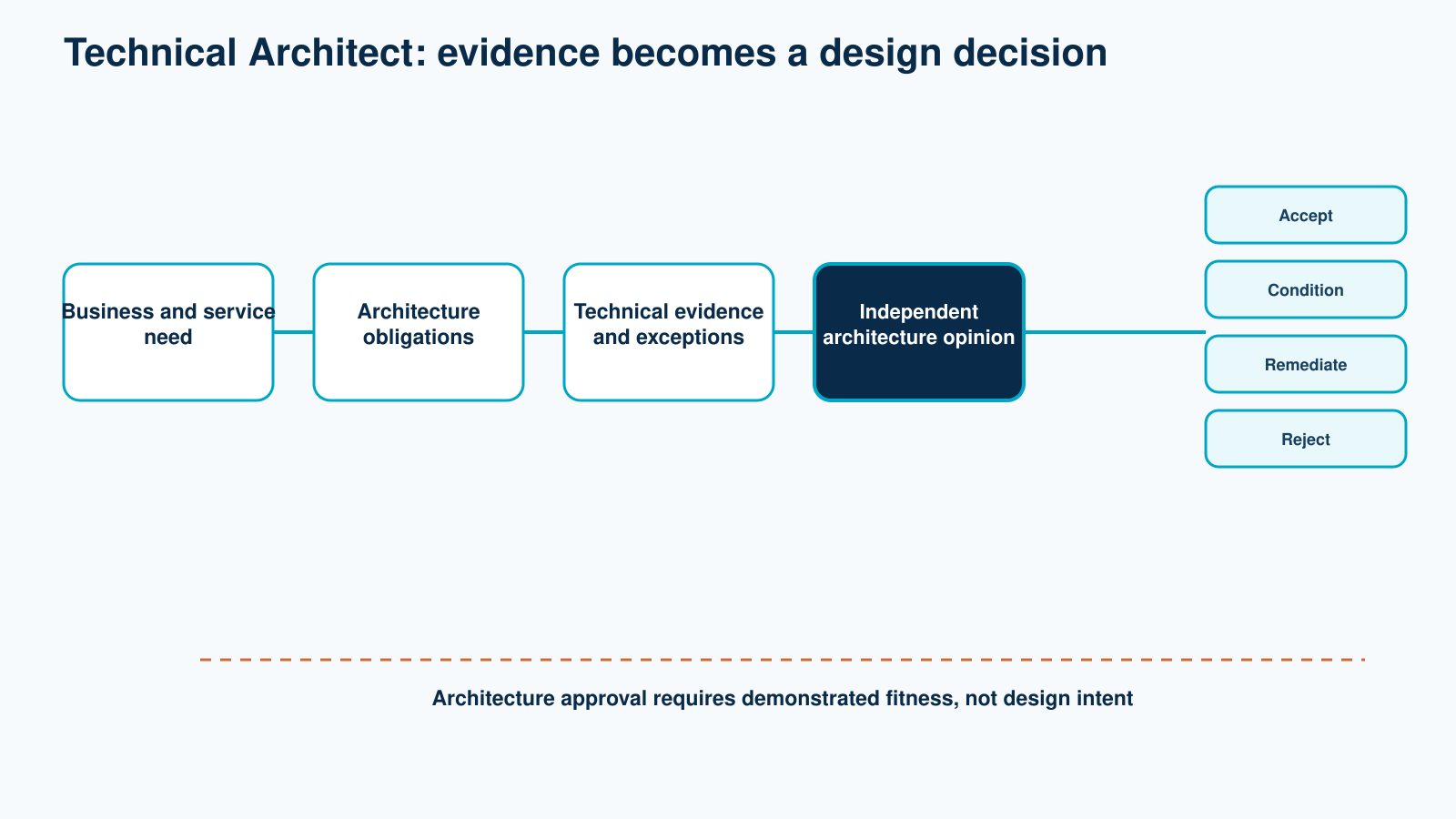
What the Technical Architect examines
Fitness for purpose
The review tests whether the design supports the service outcomes, users, transaction volumes, information needs and operating model that justify the investment. It identifies where architecture choices solve a supplier delivery problem while leaving the client with an operating, commercial or change constraint.
Decision integrity and traceability
Material decisions should have an owner, rationale, evidence basis and recorded consequence. The Technical Architect examines principles, standards, decision records, exceptions and design dependencies to determine whether the architecture remains coherent as scope and delivery conditions change.
Security, privacy and information control
Assurance examines whether security and privacy obligations have been translated into design controls and verified evidence. It tests identity, access, logging, segregation, data protection, vulnerability treatment and the ownership of residual risks without presenting certification that has not been independently established.
Integration and data
The role reviews interfaces, ownership boundaries, error handling, reconciliation, data lineage and dependency behaviour. Particular attention is given to assumptions that sit between suppliers, environments or business teams, because these gaps frequently remain invisible in component-level reporting.
Resilience, performance and operability
Architecture is tested against realistic demand, failure and recovery conditions. The Technical Architect examines capacity assumptions, performance evidence, availability design, monitoring, backup, recovery, deployment, support and the operational acceptance needed before the client relies on the service.
Technical debt and exception control
Temporary decisions become permanent exposure when they lack owners, expiry conditions or remediation evidence. Assurance distinguishes tolerable debt from unmanaged design erosion and makes the consequence visible to programme governance.
How the discipline works with other practitioners
Technical confidence is combined with programme, quality and operational evidence. The Technical Architect works with Programme Directors on viability and investment consequences, Programme Managers on dependencies and executable milestones, Heads of Test and Senior QA practitioners on non-functional and integration evidence, and Scrum Masters on technical flow, impediments and completion integrity.
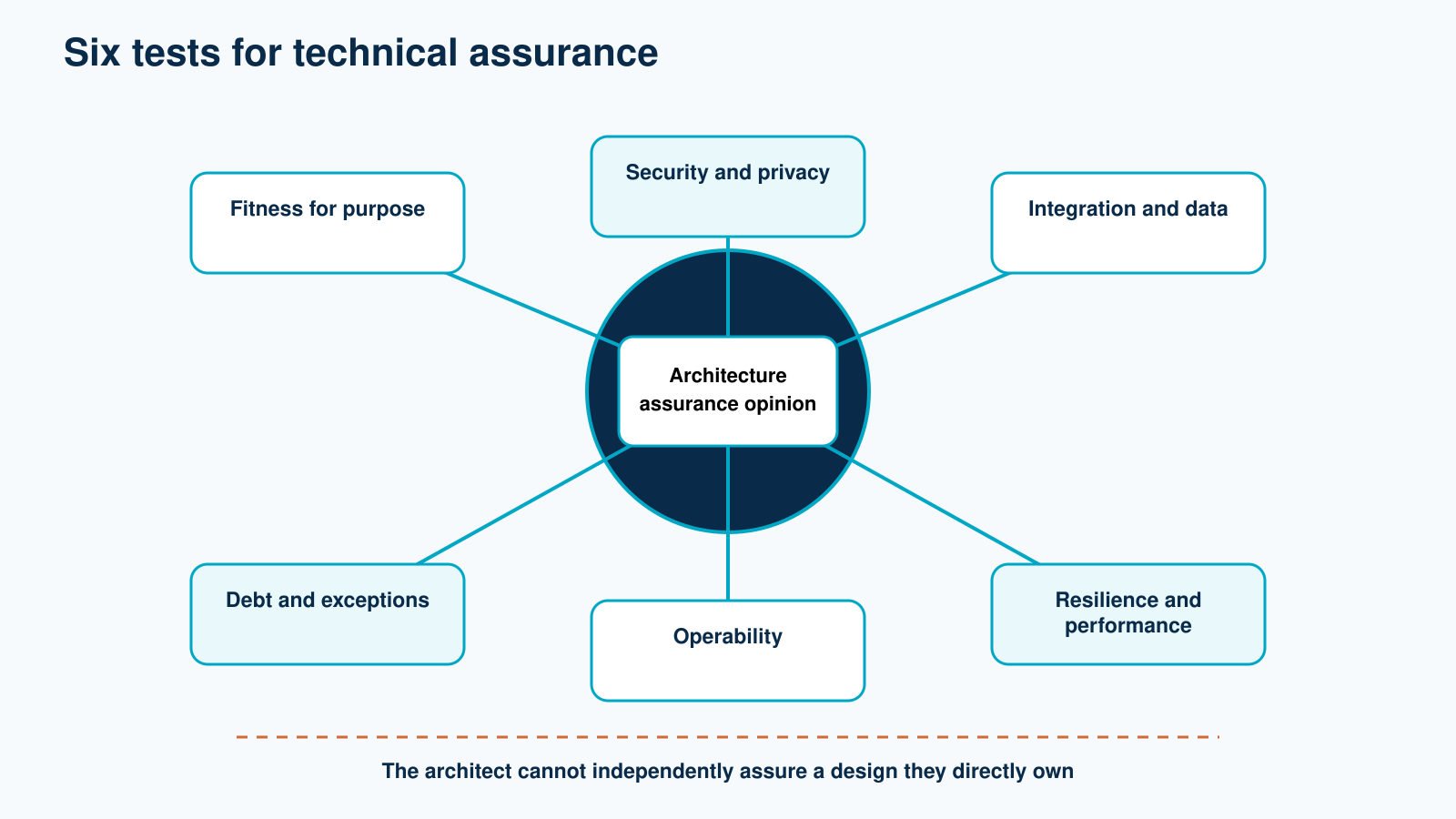
The six technical assurance tests
- Outcome fit: the design supports the client’s service and business outcomes.
- Decision traceability: obligations, assumptions, standards and exceptions are connected to accountable decisions.
- Security and privacy: controls are designed, implemented and supported by relevant evidence.
- Integration and data: interfaces, information movement, reconciliation and ownership boundaries are credible.
- Resilience and performance: realistic demand, failure, recovery and degradation conditions have been addressed.
- Operability and change: the solution can be deployed, supported, monitored, recovered and evolved in the target environment.
Independence boundary
A Technical Architect cannot independently assure an architecture, design decision or technical control they directly own. Where an Enigma practitioner has contributed to delivery, that scope is declared and excluded from their assurance conclusion, or examined by a separate practitioner with an independent reporting route.
Typical assurance outputs
- an executive technical confidence opinion linked to the client decision;
- architecture evidence sufficiency assessment;
- decision, assumption, dependency and exception analysis;
- security, privacy, integration and non-functional exposure summary;
- conditions for acceptance with accountable owners and closure evidence;
- prioritised technical remediation actions;
- record of residual exposure and governance acceptance;
- verification of agreed finding closure.
What the client should expect
The Technical Architect should leave governance with a concise distinction between what has been demonstrated, what remains assumed and what must change before the decision is defensible. Conclusions are proportionate to the decision and expressed in business and operational consequences, not architecture terminology alone.
This capability supports Independent Delivery Assurance, Quality and Test Assurance and Data Migration and Cutover Assurance. The engagement follows Enigma’s Evidence-to-Decision Assurance Model.
Discuss an independent technical architecture assurance review.