
Anonymous practitioner authority profile
This profile represents a senior Head of Test discipline informed by recurring conditions observed across public and private-sector technology delivery. It is deliberately nameless and does not represent a claimed individual biography, employer history, qualification or named engagement.
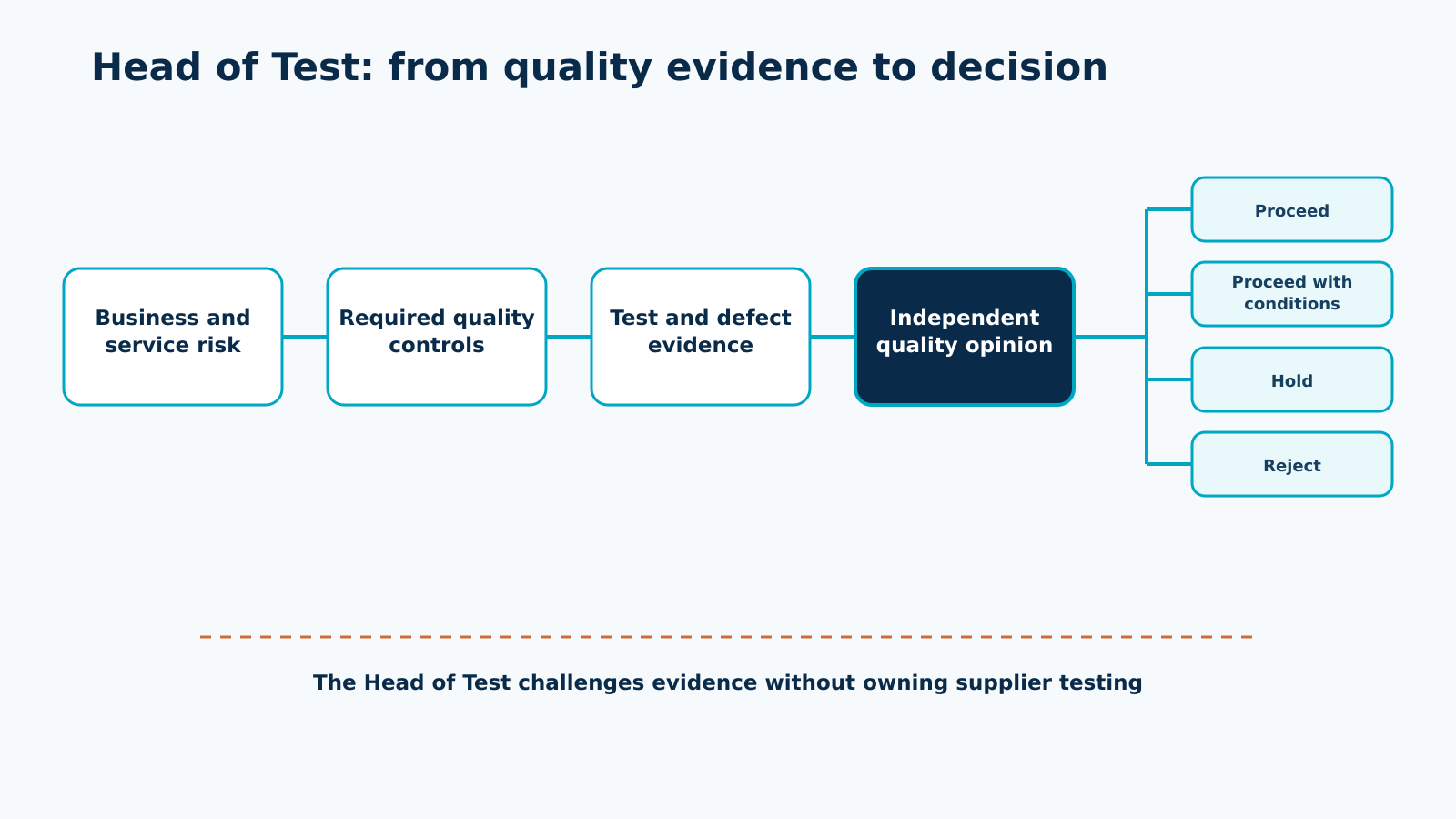
A Head of Test in an independent assurance engagement is not there to run the supplier’s test team or to produce another layer of status reporting. The role is to determine whether quality evidence is sufficient for the client to make and defend a decision.
Enigma sits on the client’s side of the table. The Head of Test challenges delivery evidence on behalf of the organisation that owns the outcome, operational consequence and acceptance risk.
The assurance question
The core question is not whether testing is busy, whether scripts have been executed or whether a dashboard is green. It is whether the available evidence supports the decision being requested of governance.
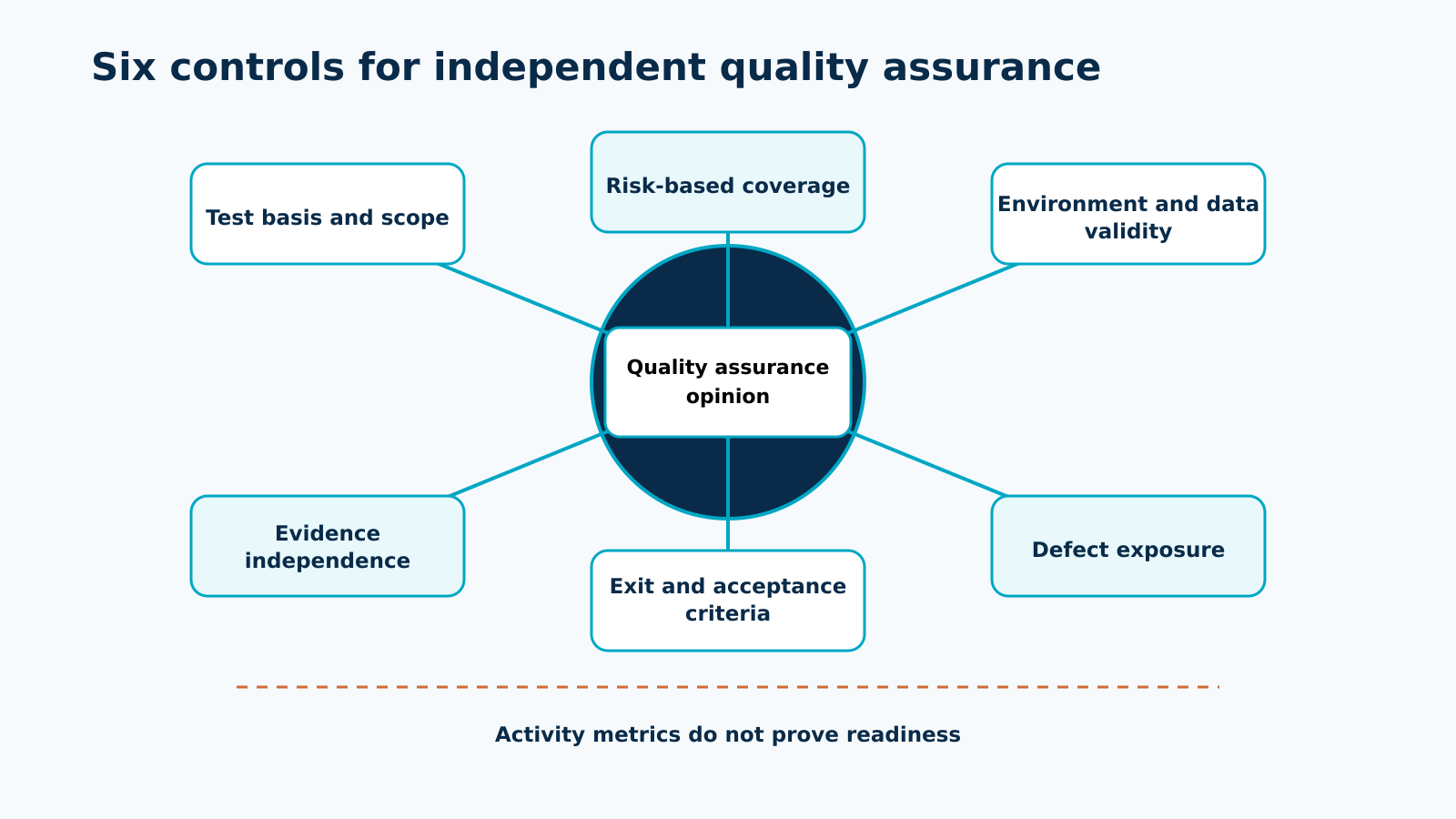
- Is the test basis complete, current and traceable to business and technical obligations?
- Has the supplier demonstrated solution quality across the relevant functional and non-functional risks?
- Are environments, interfaces, test data and dependencies representative enough for the results to be relied upon?
- Are defects understood in terms of business impact, concentration, recurrence and residual exposure?
- Has the business performed meaningful acceptance rather than simply witnessing supplier activity?
- Can governance distinguish verified evidence from assertion, forecast and assumption?
Evidence examined
The discipline examines quality strategy, requirements and acceptance traceability, supplier test plans and results, system and integration coverage, environments, test data, defect evidence, business acceptance, migration and reconciliation evidence, cutover rehearsals, operational readiness and the exceptions or assumptions carried into governance decisions.
Evidence is tested for sufficiency, provenance and relevance to the decision. Completion percentages are not treated as proof where they do not demonstrate coverage, outcome or risk retirement. This approach aligns with Enigma’s Evidence Sufficiency Standard.
What the Head of Test assesses
Quality strategy and control design
The role tests whether the quality strategy reflects the programme’s actual risk, delivery model, supplier boundaries and acceptance obligations. It examines phase entry and exit criteria, evidence ownership, escalation thresholds, independence, traceability and the treatment of exceptions.
Supplier system testing
Supplier responsibility for system testing must remain explicit. The Head of Test assesses the credibility of the supplier’s plans, coverage, execution records, defects and exit position. Assurance does not absorb incomplete supplier testing into later client phases.
Integration and end-to-end confidence
The role examines whether critical processes have been tested across organisational, technical and supplier boundaries. Particular attention is given to ownership gaps, interface assumptions, data movement, exception paths, batch processing, security dependencies and operational support.
Business acceptance
User acceptance testing must establish business fitness for use. The Head of Test checks that business owners understand their accountability, acceptance criteria are explicit, scenarios reflect real operations and accepted limitations are recorded through governance.
Migration, cutover and operational readiness
Quality assurance cannot stop at application testing. The role integrates migration reconciliation, business validation, cutover rehearsal, rollback, service transition, support readiness and early-life controls into the final confidence position.
This work forms part of Enigma’s Quality and Test Assurance capability and the wider Independent Delivery Assurance model.
Decisions supported
The discipline supports evidence-based decisions on entry to major test phases, business acceptance, defect and residual-risk treatment, migration and cutover readiness, go-live and whether supplier quality evidence is sufficient for the client to proceed. The accountable client retains the decision.
Recurring success and failure patterns
Across public and private-sector delivery, recurring failure conditions include activity being mistaken for evidence, weak traceability, supplier testing debt moving into client phases, unrepresentative environments or data, defects being assessed individually rather than cumulatively, acceptance criteria being softened to protect dates and unresolved migration or operational risks being treated as separate from the go-live decision.
Stronger programmes show the opposite behaviours: explicit quality ownership, representative evidence, testable acceptance criteria, transparent defects, controlled exceptions, credible supplier exit evidence and governance prepared to change course when evidence no longer supports progression.
How the discipline works with other practitioners
A Head of Test cannot establish programme confidence alone. Quality evidence is interpreted alongside programme viability, delivery controls, architecture, agile flow, migration and operational readiness.
- Programme Directors connect quality exposure to viability, governance and executive decisions.
- Programme Managers test whether plans, dependencies, resources and recovery commitments are executable.
- Senior QA practitioners perform detailed examination of traceability, coverage, defects, test data, environments and execution evidence.
- Scrum Masters examine flow, impediments, definition controls and whether reported progress represents completed outcomes.
- Technical Architects assess architecture decisions, integrations, non-functional risks, operability and technical readiness.
Independence boundary
The same person or reporting line must not own a delivery activity and provide the independent assurance opinion on that activity. Where an Enigma practitioner has contributed directly to delivery, that area is excluded from their assurance scope or examined through a separate independent route.
This boundary is defined through the Assurance Mandate and Independence and Conflict Standard.
Typical assurance outputs
- quality confidence opinion for programme governance;
- evidence sufficiency assessment;
- test strategy and control-gap review;
- phase readiness assessment against explicit entry and exit criteria;
- supplier testing evidence challenge;
- defect exposure and acceptance analysis;
- prioritised remediation conditions;
- record of assumptions, exceptions and accepted residual risk;
- verification that agreed findings have been closed effectively.
What the client should expect
The Head of Test should leave governance with a clearer, more defensible position. The output distinguishes what has been demonstrated, what remains uncertain, what must be corrected, who owns the action and what consequence follows if the programme proceeds.
Return to Our Expertise or review How We Assure.