
Practitioner authority profile
A Programme Director in an independent assurance engagement is not there to take over the programme, defend its existing plan or provide executive cover for delivery owners. The role determines whether the programme remains viable, whether governance is receiving a reliable account of reality and whether the proposed decisions protect the client’s intended outcomes.
Enigma sits on the client’s side of the table. The Programme Director challenges viability, governance and delivery evidence for the organisation that owns the investment, public service consequence and final decision.
The assurance question
The central question is not whether activity continues or whether the programme can produce another recovery plan. It is whether the programme still has a credible route to worthwhile outcomes within an exposure the client understands and is prepared to own.
- Is the intended outcome still valuable, achievable and aligned to current organisational priorities?
- Can governance distinguish verified position from supplier assertion, forecast and unmanaged assumption?
- Is the integrated plan executable across scope, dependencies, resources, architecture, quality, migration and cutover?
- Are cost and schedule forecasts based on remaining work and demonstrated performance?
- Are decision rights, accountabilities and escalation routes functioning in practice?
- Do recovery proposals remove causes and constraints, or merely reset dates?
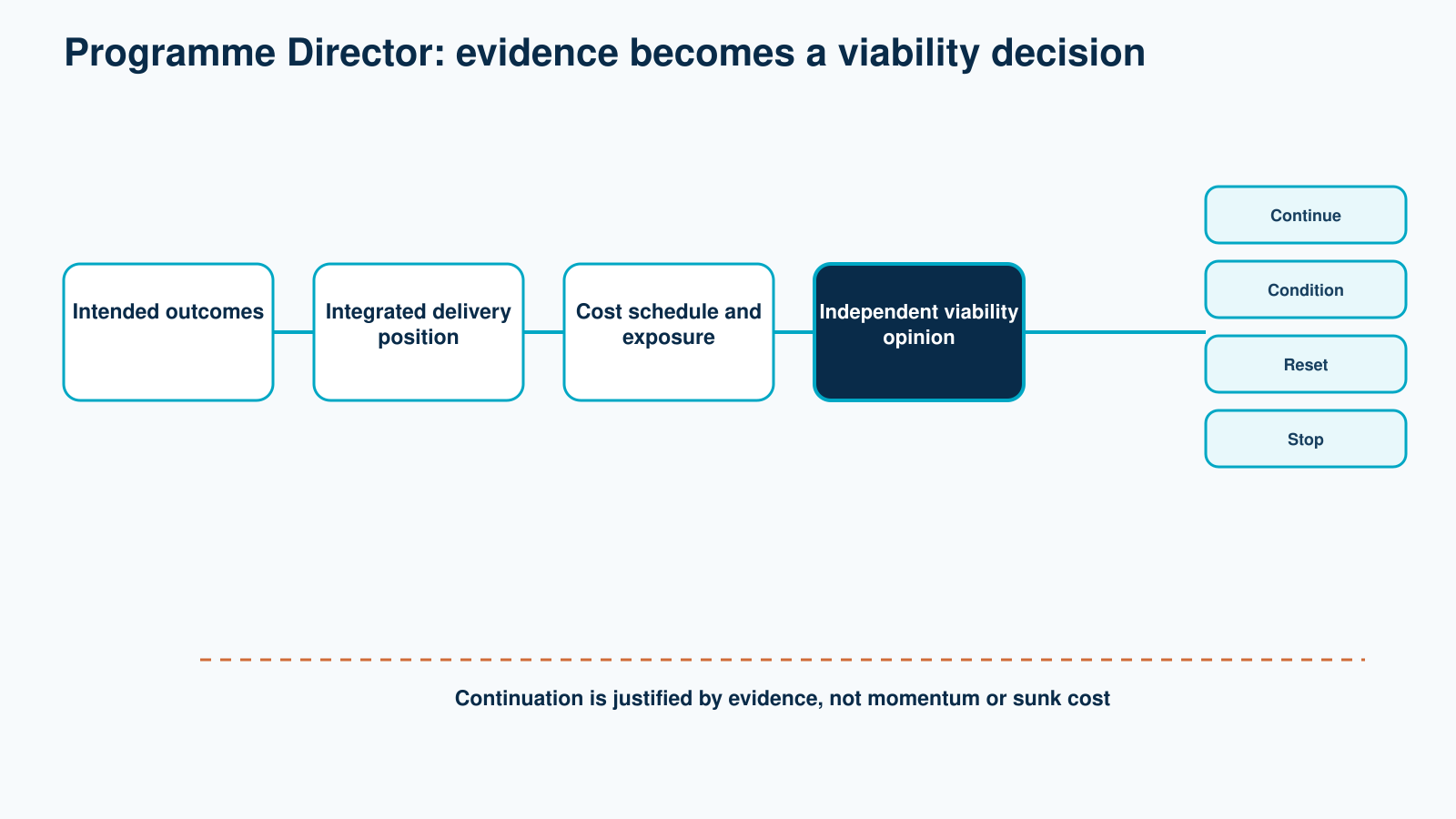
What the Programme Director examines
Outcome and strategic viability
The role tests whether the original case for change remains valid after changes in policy, service demand, technology, cost and organisational capacity. It examines whether intended benefits remain measurable, whether scope still serves those benefits and whether continuation represents better value than reset, reduction or termination.
Governance and decision integrity
Effective governance requires more than regular meetings and complete packs. The Programme Director examines the quality and timeliness of decisions, the clarity of delegated authority, the treatment of dissent, the escalation of exceptions and whether actions are closed through evidence. Risks must reach the body with authority to accept or mitigate them.
Integrated delivery credibility
The programme cannot be judged through separate workstream reports. The role tests the integrated route through supplier delivery, client activity, architecture, data, testing, business change, cutover and operational readiness. Dependencies without accountable owners, dates or acceptance evidence remain unmanaged exposure.
Forecast reliability
The Programme Director challenges whether forecast cost and completion dates reflect remaining work, historical performance, resource constraints, decision latency and unresolved uncertainty. A repeatedly moved baseline does not establish control. Confidence must be linked to evidence and stated assumptions.
Supplier and client accountability
Supplier obligations must remain with the supplier, and client accountabilities must remain visible. Independent assurance must not become a mechanism for absorbing missing delivery management, incomplete testing or weak acceptance. The role identifies responsibility gaps and forces them into explicit governance decisions.
Recovery realism
A credible recovery plan addresses root causes, stops further deterioration and establishes measurable control points. It must be resourced, dependency-aware and governed through objective evidence. Replanning without correcting decision, capability, scope or supplier constraints simply postpones the next failure.
This work anchors Enigma’s Programme Health Checks and Recovery capability within the wider Independent Delivery Assurance model. The evidence and confidence process is set out in How We Assure.
How the discipline works with other practitioners
The Programme Director integrates specialist findings into one client-side view of viability. This is a multidisciplinary assurance capability, not a catalogue of individual contractors.
- Programme Managers test whether the integrated plan, dependencies, resources, controls and recovery commitments are executable.
- Head of Test determines whether quality evidence supports the phase or release decision.
- Senior QA examines traceability, coverage, execution integrity, defects, test data and environments.
- Scrum Masters assess delivery flow, impediments, completion discipline and whether reported progress represents usable outcomes.
- Technical Architects assess technical feasibility, integration, security, resilience, operability and architectural debt.
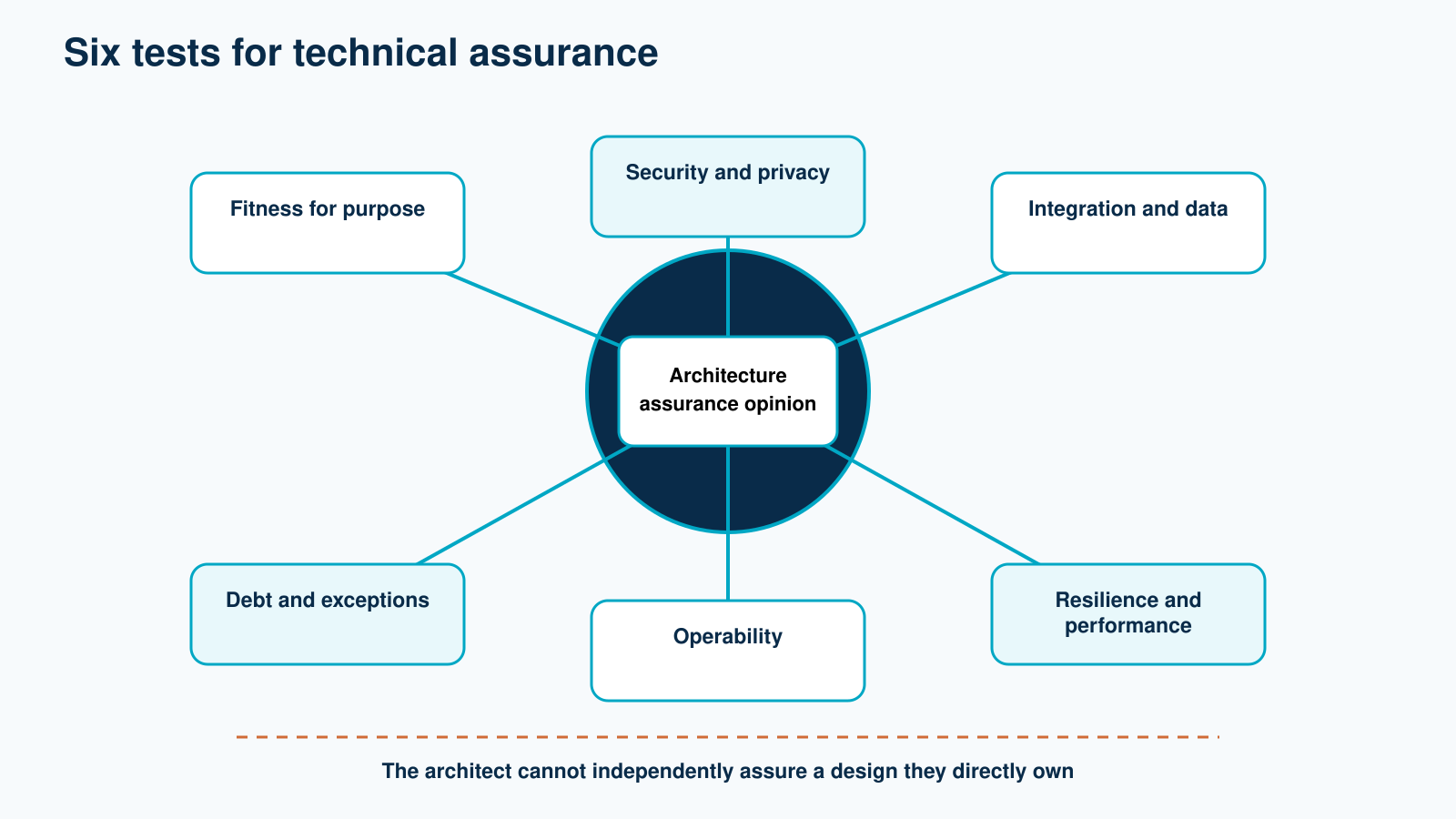
Independence boundary
A Programme Director must not issue an independent opinion over governance, planning or delivery that they directly own. Where an Enigma practitioner has acted as the programme’s delivery director, the affected scope must be excluded or assured through a separately appointed practitioner with an independent reporting route.
This discipline is governed by Enigma’s assurance approach and Independence and Conflict Standard, which apply the conflict boundary required for client-side assurance.
Typical assurance outputs
- programme viability opinion;
- governance and decision-effectiveness assessment;
- integrated delivery credibility assessment;
- forecast confidence and assumption review;
- supplier and client accountability findings;
- recovery options with conditions, consequences and decision points;
- prioritised actions with accountable owners and verification evidence;
- record of unresolved uncertainty and accepted residual exposure;
- follow-up confirmation that recovery controls are operating effectively.
What the client should expect
The client should receive a defensible decision position, not a rewritten status report. The output must state what has been demonstrated, what remains uncertain, whether the programme is viable, what conditions apply and what consequence follows if governance chooses to proceed regardless.
Resource route: Programme Viability Decision Record. Link withheld until the resource is created, its final filename is confirmed and download availability is verified.
To discuss a defined assurance decision, use Enigma’s contact page.