
Procurement confidence depends on verifiable company information, explicit independence controls and a scope tied to a real client decision.
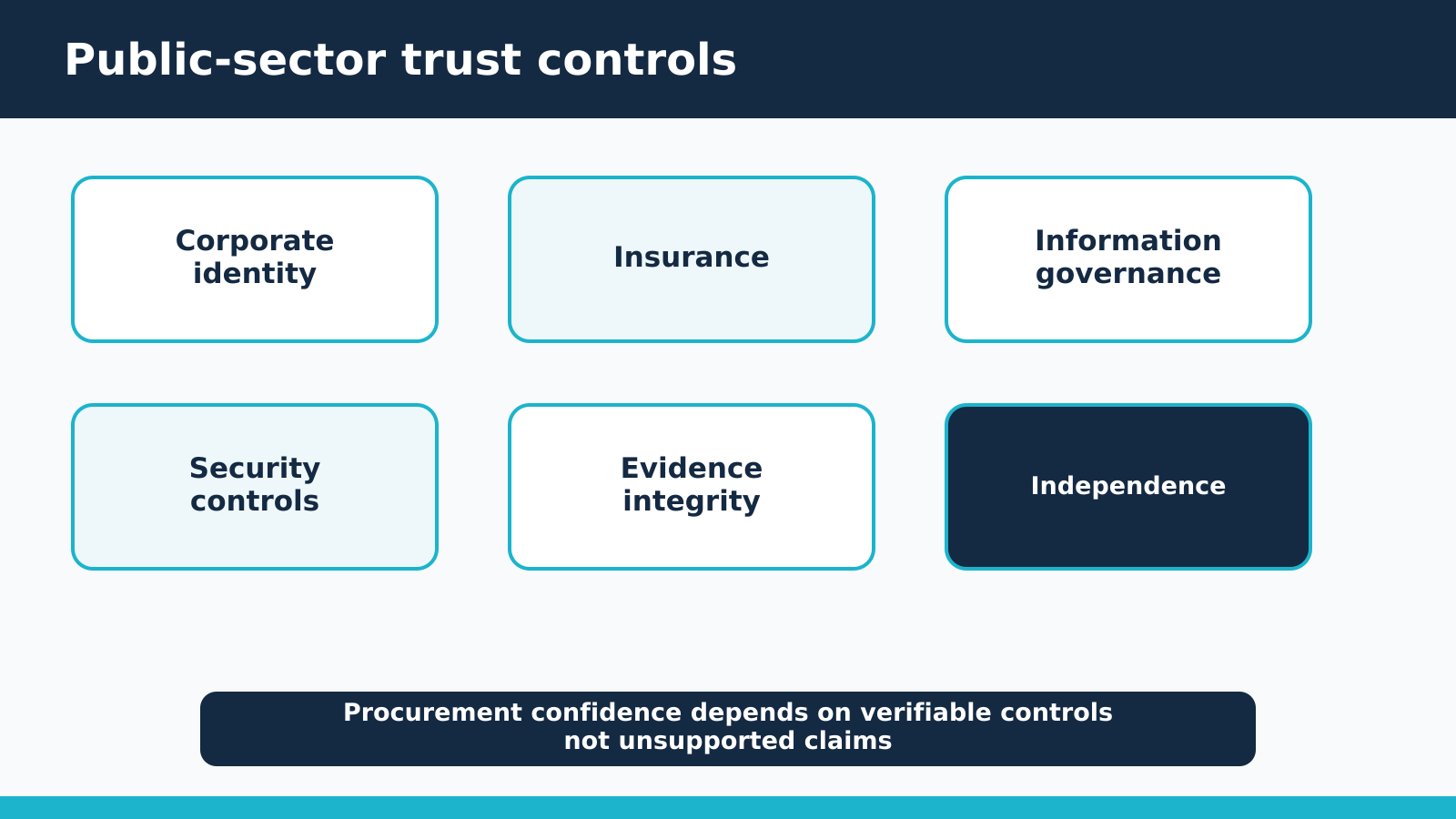
This page provides a factual due-diligence route for organisations considering Enigma Consulting Ltd for independent technology delivery assurance. It is deliberately limited to information that is already evidenced on this website or that can be verified for a specific procurement. It does not assert framework participation, certifications, insurance limits, accessibility conformance, subcontracting arrangements or prime-contractor access where those facts have not been established.
Legal and trading identity
The legal entity identified across this website is Enigma Consulting Ltd. Enigma describes itself as a UK independent technology advisory and delivery assurance consultancy working on the client side of the table. The current operating model, sectors and assurance disciplines are set out on About Enigma.
Where a procurement requires formal company-number, registered-office, contracting-authority or banking evidence, those items should be verified from the relevant corporate documents before award rather than inferred from website copy.
Independence and conflicts
Enigma’s published assurance model separates delivery ownership from assurance judgement. A practitioner should not independently assure delivery they directly own. The applicable control model is described in the Independence and Conflict Standard, supported by the Assurance Mandate.
For a defined engagement, the statement of work should record reporting lines, exclusions, conflicts, evidence access and escalation rights before assurance begins.
Information handling and website privacy
The published Privacy Policy states how Enigma Consulting Ltd collects, uses, protects and shares information provided through the website or services. It also states that information is not sold, rented or shared with third parties for their own marketing purposes, while allowing use of service providers and legally required disclosure.
The Cookie Policy explains the site’s consent model and identifies the current cookie categories and services described by Enigma. It states that non-essential cookies are not enabled until consent is given through the cookie banner.
These published policies support website-level due diligence. They do not, by themselves, evidence every UK GDPR obligation or information-security control that may apply to a client engagement, nor do they establish any formal information-security certification. Engagement-specific requirements should therefore be defined and verified through the procurement and contracting process. Where an engagement requires specific controls for client data, privileged material, secure transfer, retention, deletion, incident handling or access restriction, those requirements should be agreed explicitly in the engagement terms and evidenced for that procurement.
Evidence and audit trail
Assurance conclusions should trace to current, attributable evidence and preserve material contrary evidence and limitations. Enigma’s Evidence Sufficiency Standard defines the threshold used to distinguish a supported conclusion from an assertion.
The engagement record should identify what was examined, what was unavailable, which assumptions remained, the basis of confidence and any decision conditions or residual risks carried forward.
Buyer due diligence
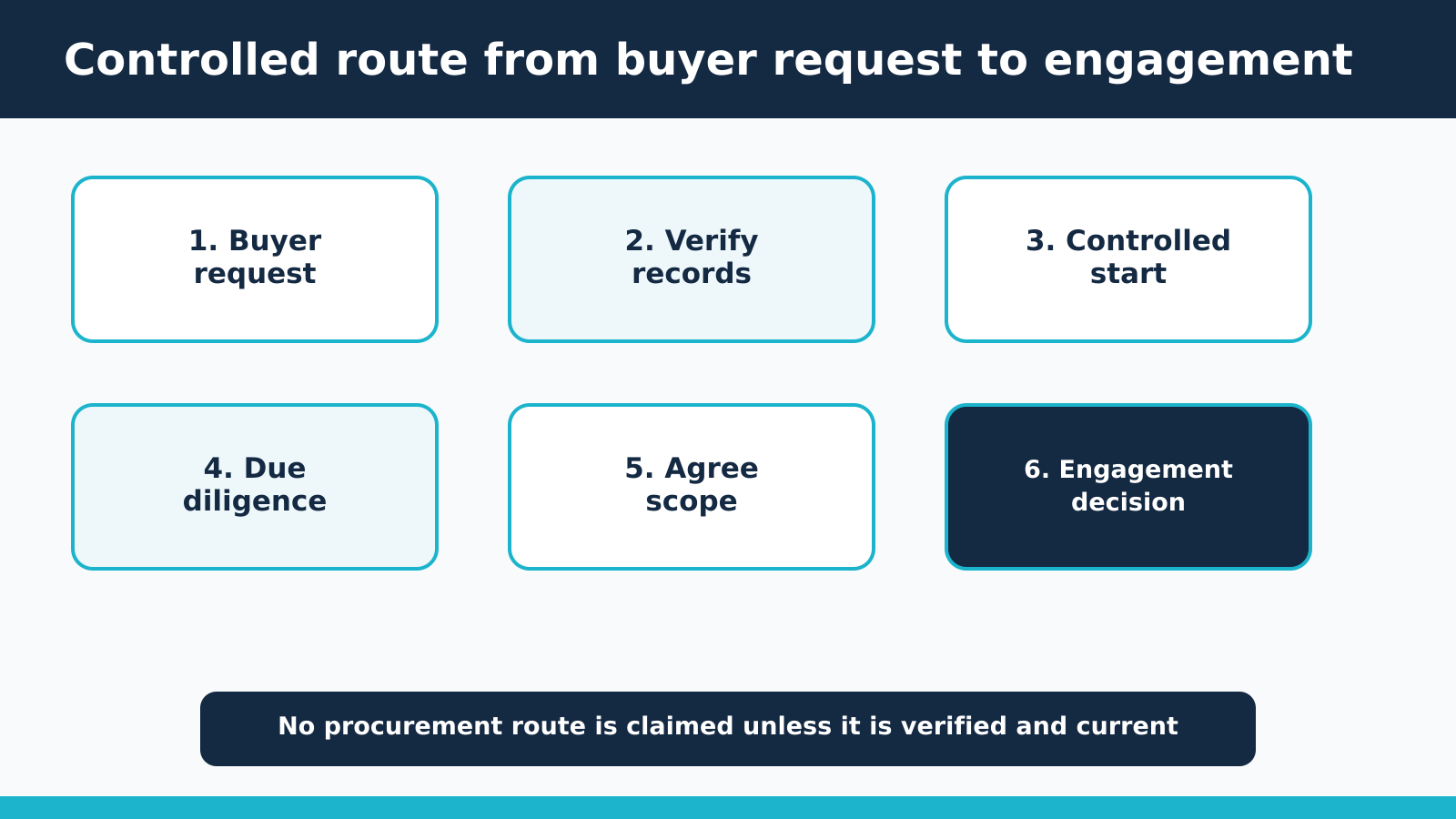
- Confirm the legal entity, company number, registered address and contracting contact from current corporate evidence.
- Request relevant insurance certificates and limits for the proposed scope where required.
- Agree information-handling, access, retention, secure-disposal and incident-notification requirements for the engagement.
- Confirm whether any associate, subcontractor or third party will be used and how accountability and quality control will operate.
- Confirm accessibility and inclusive-communication requirements applicable to the procurement.
- Verify any claimed procurement route, framework status or ability to work through a prime before relying on it.
Commercial and procurement routes
The appropriate route depends on the buyer’s procurement rules, contract value and available commercial mechanisms. A route may involve direct consultancy procurement, a competitive process, an approved framework or delivery through a prime, but this page does not claim that Enigma currently holds any particular framework position or prime arrangement.
For a specific opportunity, the route and Enigma’s status within it should be verified before award. The available engagement structures are described separately on Engagement Models.
Accessibility and subcontracting
No standalone accessibility statement is currently published on this site, so this page does not claim formal accessibility conformance. Any accessibility obligations for deliverables, communications or client systems should therefore be stated explicitly in the procurement and engagement requirements.
This page also does not assert a standing subcontracting or associate model. Where additional practitioners or third parties are proposed for an engagement, their role, accountability, confidentiality obligations and independence position should be disclosed and agreed before work starts.
What a good statement of work should contain
- The assurance question and accountable decision authority.
- Scope, exclusions, evidence access and named stakeholders.
- Independence declaration and conflict controls.
- Method, review points, deliverables and acceptance criteria.
- Reporting, escalation, confidentiality and information handling.
- Fees, assumptions, dependencies and change control.
- Any verified insurance, procurement, accessibility or third-party requirements that apply to the engagement.
Contact and procurement enquiries
The published contact route is the Independent Assurance Enquiry form. It asks for the essential context needed for an initial assurance discussion so that the evidence, decision and delivery position can be considered before an engagement is established.
Procurement-specific evidence that is not published on the website, such as current corporate records, insurance evidence where required, proposed third-party arrangements or opportunity-specific commercial information, should be requested and verified through the procurement process. Absence of a claim on this page should not be interpreted as evidence that a capability, certification, arrangement or status exists.
Published due-diligence status
The table below summarises what is currently evidenced on this website and what still requires opportunity-specific verification. It is a buyer aid, not a substitute for formal due diligence.
| Area | Published position |
|---|---|
| Legal entity | Enigma Consulting Ltd is identified across the website as the legal entity. |
| Operating position | UK independent technology advisory and delivery assurance consultancy, working on the client side of the table. |
| Independence controls | Published through the Independence and Conflict Standard and Assurance Mandate. |
| Privacy and website data handling | Published Privacy Policy and Cookie Policy are available. |
| Information security and UK GDPR | Website-level policies are published, but engagement-specific UK GDPR obligations, information-security controls and any certification claims must be verified for the proposed scope. |
| Insurance | No insurance limits are asserted on this page. Evidence should be requested and verified for the proposed engagement where required. |
| Certifications | No certification claim is made here unless independently evidenced elsewhere on the site. |
| Framework status | No current framework participation is asserted on this page. |
| Prime-contractor route | No standing prime-contractor arrangement is asserted on this page. |
| Subcontracting or associate model | No standing model is asserted. Any proposed third-party involvement should be disclosed for the specific engagement. |
| Accessibility conformance | No standalone accessibility statement is currently published and no formal conformance claim is made here. |
Where the published position is deliberately limited, the absence of a claim should not be treated as evidence that a certification, procurement status, insurance level or commercial arrangement exists. Buyers should request current evidence for the specific opportunity.
Evidence-controlled claims
Enigma states corporate, insurance, certification, procurement and framework information only where supporting evidence can be verified. Buyers should request the relevant evidence for the defined opportunity rather than rely on assumptions or generic marketing claims.
For the wider assurance model, see How We Assure. To discuss a specific decision and commissioning route, start an assurance conversation.