
Practitioner authority profile
A Programme Manager in an independent assurance engagement is not there to maintain the supplier’s plan, administer governance or conceal delivery gaps through better reporting. The role tests whether the programme’s commitments are coherent, integrated and executable, and whether management controls expose problems early enough for the client to act.
Enigma sits on the client’s side of the table. The Programme Manager challenges plans, dependencies and controls for the organisation that owns the outcome, investment and operational consequence.
The assurance question
The question is not whether a plan exists or whether milestones are shown as green. It is whether the combined programme can deliver the required outcome through a credible sequence of decisions, work, evidence and operational preparation.
- Does the integrated plan contain all material supplier, client, technical, quality, migration, cutover and business-change activity?
- Are dependencies linked to accountable owners, required dates, acceptance evidence and escalation thresholds?
- Do resources, environments, data, decisions and specialist capabilities exist when the plan requires them?
- Are milestones defined by completed outcomes and evidence rather than activity or elapsed time?
- Do risks, issues, assumptions and decisions change the plan and forecast when they should?
- Can recovery commitments be executed without creating hidden scope, quality or operational exposure?
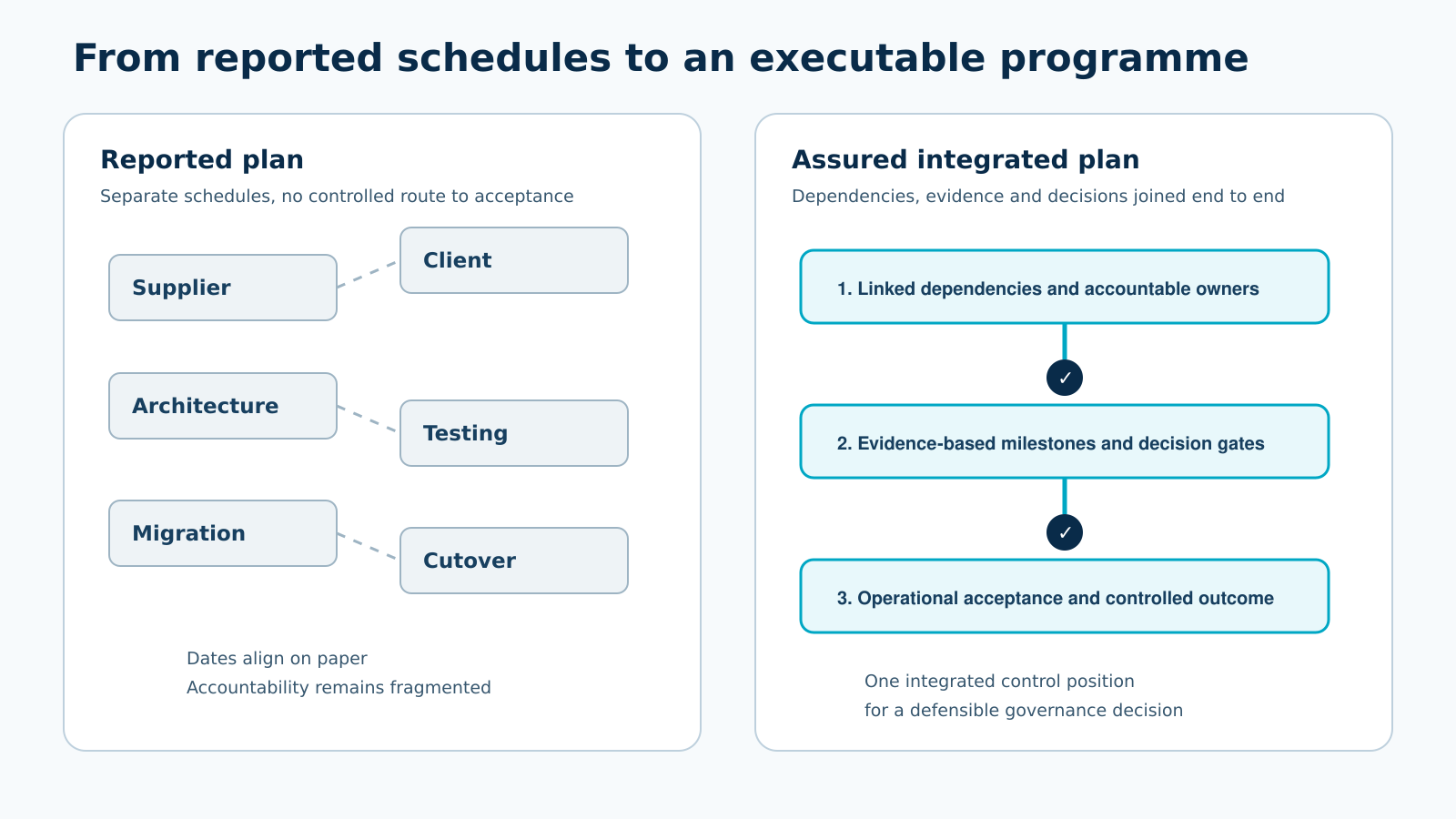
What the Programme Manager examines
Integrated planning
The role tests whether the plan represents the complete route to an accepted and operable outcome. Supplier delivery dates must connect to client decisions, environments, interfaces, test phases, data migration cycles, training, cutover and service transition. Work omitted from the integrated plan is not controlled simply because it appears in a separate workstream document.
Dependency control
Dependencies require more than a description and target date. The Programme Manager checks the provider, receiver, acceptance condition, evidence, lead time and consequence of failure. Cross-supplier and client-owned dependencies receive particular scrutiny because they are where fragmented accountability most often becomes programme delay.
Milestones and evidence
A milestone should represent a completed, verifiable state. The practitioner tests whether milestone definitions include objective completion criteria, required evidence and accountable acceptance. Percentage complete, planned dates and verbal confidence are insufficient where the underlying outcome cannot be inspected.
Resources and constraints
The role examines whether the people, decisions, environments, data, funding and specialist capability assumed by the plan are genuinely available. Resource conflicts and approval latency must be reflected in forecasts. A plan based on uncommitted capacity is a scenario, not a controlled delivery position.
Risk, issue and decision integration
Risks and issues must influence sequencing, contingency, cost and governance decisions. The Programme Manager checks whether assumptions have owners and expiry points, whether decisions are taken by the correct authority and whether overdue actions have a visible consequence. Separate registers that do not change delivery behaviour provide administrative comfort, not control.
Recovery execution
A recovery plan must show how control will be restored, not merely provide revised dates. The practitioner tests root-cause actions, critical-path changes, resource commitments, supplier obligations, quality consequences, decision gates and verification points. Recovery that depends on sustained exceptional effort or deferred assurance is not credible.
This work supports Enigma’s Programme Health Checks and Recovery and Supplier Delivery Assurance capabilities. The evidence and confidence process is defined in How We Assure.
How the discipline works with other practitioners
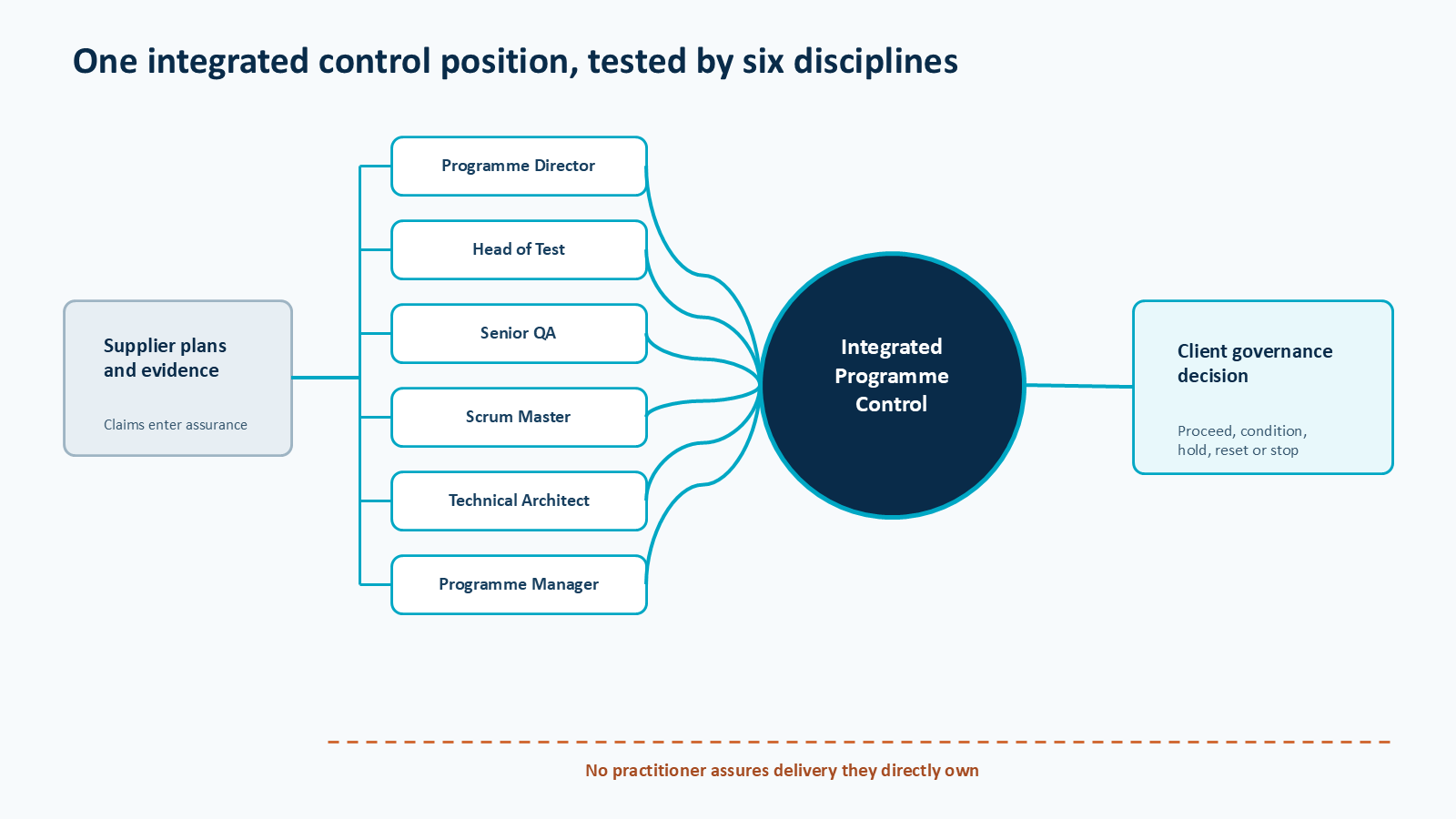
The Programme Manager provides the integrated control view within a multidisciplinary assurance capability. It does not operate as outsourced programme administration or as a catalogue of contractors.
- Programme Directors connect delivery credibility to viability, governance and executive decisions.
- Head of Test tests whether quality evidence and phase controls support planned progression.
- Senior QA examines detailed traceability, coverage, execution integrity, defects, data and environments.
- Scrum Masters assess delivery flow, impediments and whether completed work is represented accurately in the programme plan.
- Technical Architects test technical dependencies, decision lead times, integration readiness and operability assumptions.
Independence boundary
A Programme Manager cannot independently assure a plan, control framework or recovery commitment they directly own. If an Enigma practitioner has managed programme delivery, the affected scope must be excluded or reviewed by a separate practitioner with an independent reporting route.
This boundary is governed by Enigma’s assurance approach and Independence and Conflict Standard, which apply the separation required for an assurance opinion.
Typical assurance outputs
- integrated plan credibility assessment;
- dependency and critical-path analysis;
- milestone evidence and acceptance review;
- resource and constraint assessment;
- risk, issue, assumption and decision-control findings;
- supplier commitment and accountability assessment;
- recovery plan executability review;
- prioritised control conditions with owners and verification criteria;
- follow-up verification that agreed controls are operating.
What the client should expect
The client should receive a clear view of whether the programme plan can be executed, where commitments depend on unsupported assumptions and which conditions must be satisfied before governance relies on the forecast. Findings must connect control weaknesses to decision consequences.
Resource route: Integrated Programme Control Checklist. Link withheld until the resource is created, its final filename is confirmed and download availability is verified.
To discuss a defined assurance decision, use Enigma’s contact page.