
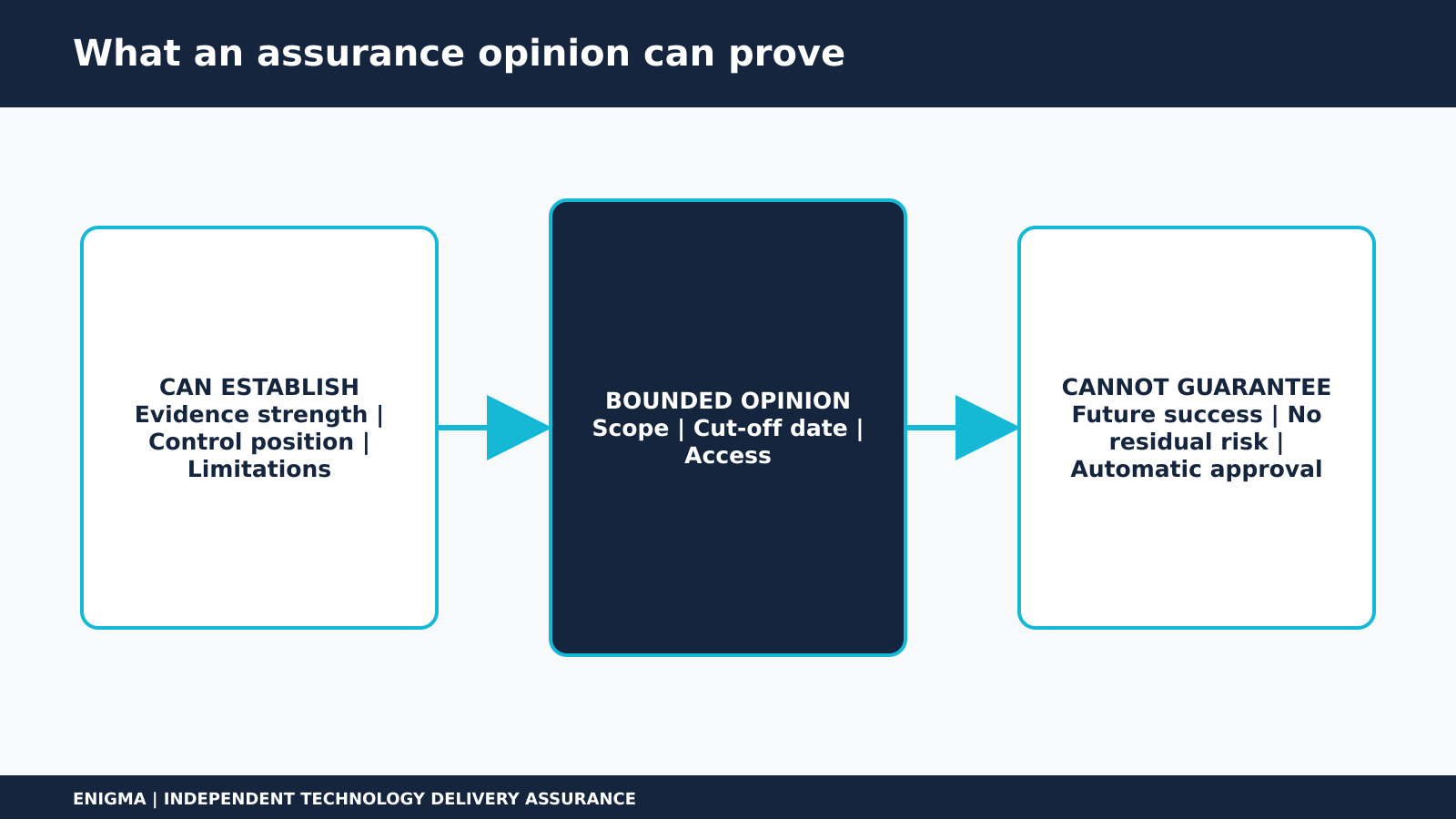
An assurance opinion can show whether a defined claim has a defensible evidence basis at a point in time. It cannot guarantee delivery success or remove accountability from the client.
Key judgement
The value of an opinion lies in its boundaries. Confidence without scope, evidence, limitations and residual uncertainty is presentation, not assurance.
The operational problem
Assurance reports are sometimes treated as certificates of health. A positive rating is repeated without its conditions, while a negative opinion is challenged because future failure is not certain. Both positions misunderstand evidence-based assurance.
The opinion tests whether reliance is reasonable within a defined mandate. It improves decision quality. It does not predict every future event, replace delivery management or make risk acceptance automatic.
What an opinion can establish
| It can establish | Subject to |
|---|---|
| Whether material claims have sufficient evidence | Evidence quality, access and the review cut-off. |
| Whether required controls operate | The period examined and ability to observe or reproduce operation. |
| Whether contradictions and uncertainty are resolved | Scope and access across relevant client and supplier records. |
| How much reliance is reasonable | The claim, rating model and stated limitations. |
| Which findings affect the decision | Consequence, materiality, evidence strength and timing. |
| What conditions are required | Clear ownership, evidence, dates and closure verification. |
What an opinion cannot establish
| It cannot prove | Reason |
|---|---|
| Delivery will definitely succeed | Future behaviour, events and external dependencies remain. |
| Areas outside scope are satisfactory | No conclusion extends beyond the mandate. |
| Missing evidence proves failure | Absence prevents reliance but does not prove the opposite claim. |
| Supplier ownership has transferred | The supplier still owns delivery and remediation. |
| The client no longer owns the decision | Approval and risk acceptance remain with accountable governance. |
| A rating stays valid indefinitely | Evidence, controls, dependencies and circumstances change. |
Anatomy of a bounded opinion
- The client decision and claims tested.
- Scope, period, evidence cut-off and exclusions.
- Criteria and obligations used.
- Evidence examined and sufficiency judgement.
- Confidence rating and material findings.
- Restrictions, limitations and unknowns.
- Conditions and required closure evidence.
- Residual risk and accountable owner.
How to read the conclusion
| Conclusion | Correct interpretation | Incorrect interpretation |
|---|---|---|
| High confidence | Evidence strongly supports the defined claim within scope. | Success is guaranteed. |
| Moderate confidence | The claim is supported with bounded limitations and conditions. | The caveats can be ignored. |
| Low confidence | The current basis for reliance is materially weak or contradicted. | Failure is certain. |
| Insufficient Evidence | A defensible conclusion cannot be reached. | The claim is automatically true or false. |
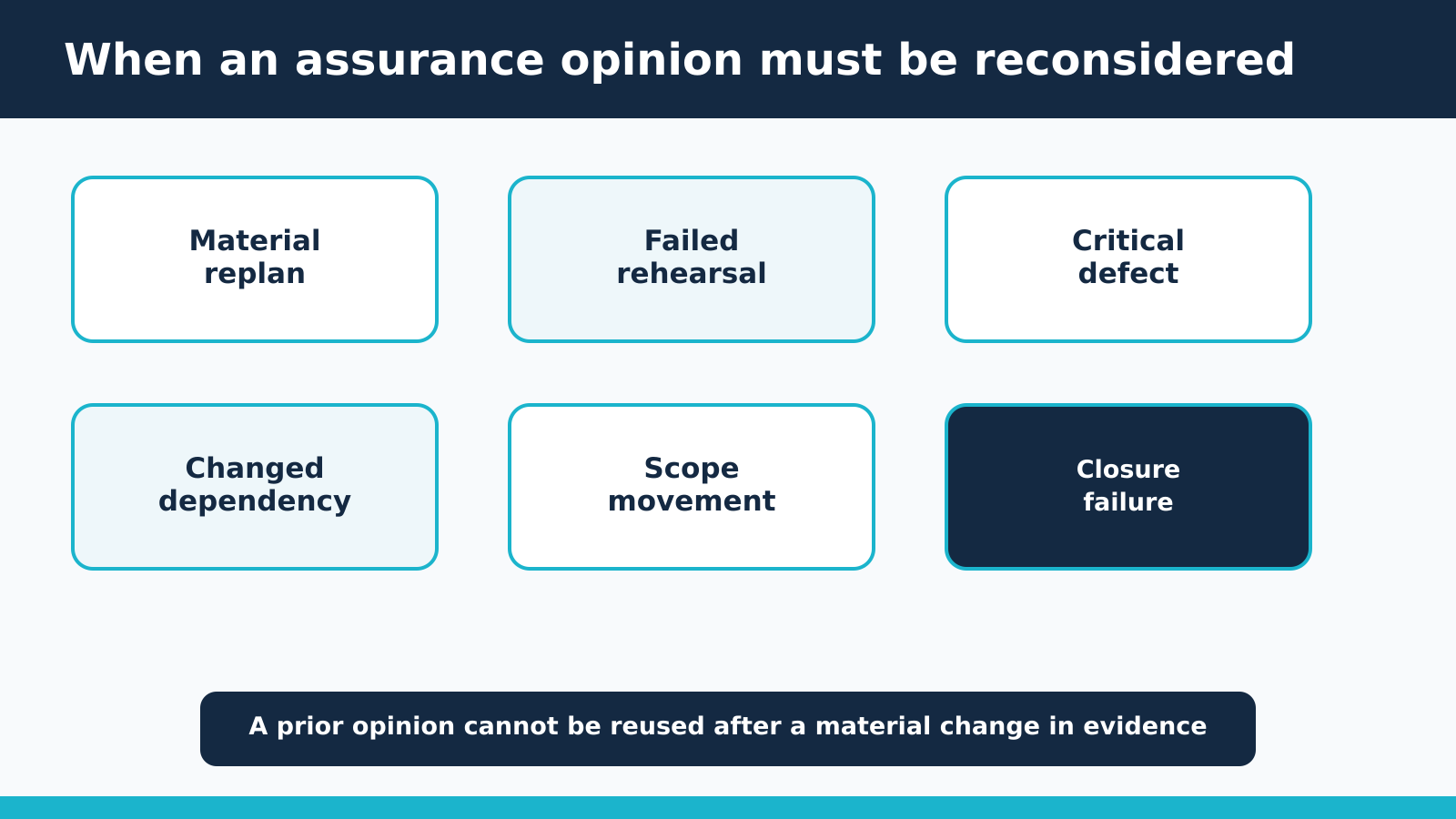
Validity over time
The opinion should state when it must be reconsidered. Triggers include a material replan, failed rehearsal, new critical defect, changed dependency, scope movement, closure failure or delayed decision. An old rating should not be carried into a materially different position.
Application by client context
| Context | Assurance focus |
|---|---|
| Central Government | Evidence for SRO and programme board decisions, multi-supplier dependency, major approvals and public accountability. |
| Local Government | Citizen service continuity, supplier challenge and proportionate scrutiny without creating a permanent council function. |
| SME | Protection of investment and operations where the technology supplier holds most technical knowledge and evidence. |
The consequence for client governance
The supplier remains responsible for delivery and for producing the evidence behind its claims. The client retains accountability for approval, acceptance and residual risk. Independent assurance gives that client a defensible basis for deciding what to rely on, what to condition and when to intervene.
Related Enigma framework pages
Independence boundary
No practitioner independently assures delivery that they directly own. Delivery support, management action and independent verification must be separated and disclosed.