
Practitioner authority profile
A Senior QA practitioner in an independent assurance engagement is not additional test execution capacity and is not a substitute for the supplier’s quality responsibilities. The role examines the detail beneath reported status and determines whether the evidence is complete, traceable, representative and credible enough to support the client’s decision.
Enigma sits on the client’s side of the table. Senior QA tests the evidence behind delivery claims for the organisation that owns the operational consequence, acceptance decision and residual risk.
The assurance question
The central question is not whether testing has taken place. It is whether the work performed demonstrates that the solution is sufficiently understood and controlled for the decision now required.
- Can requirements, risks, tests, results and defects be traced without gaps or retrospective reconstruction?
- Does the coverage address critical business processes, interfaces, data conditions, security concerns and failure paths?
- Were tests executed in environments and with data that make the results representative?
- Are pass, fail, blocked and not-run outcomes classified consistently and supported by evidence?
- Do defect trends and concentrations reveal unresolved systemic exposure?
- Have exceptions, limitations and accepted risks been recorded with accountable owners and consequences?
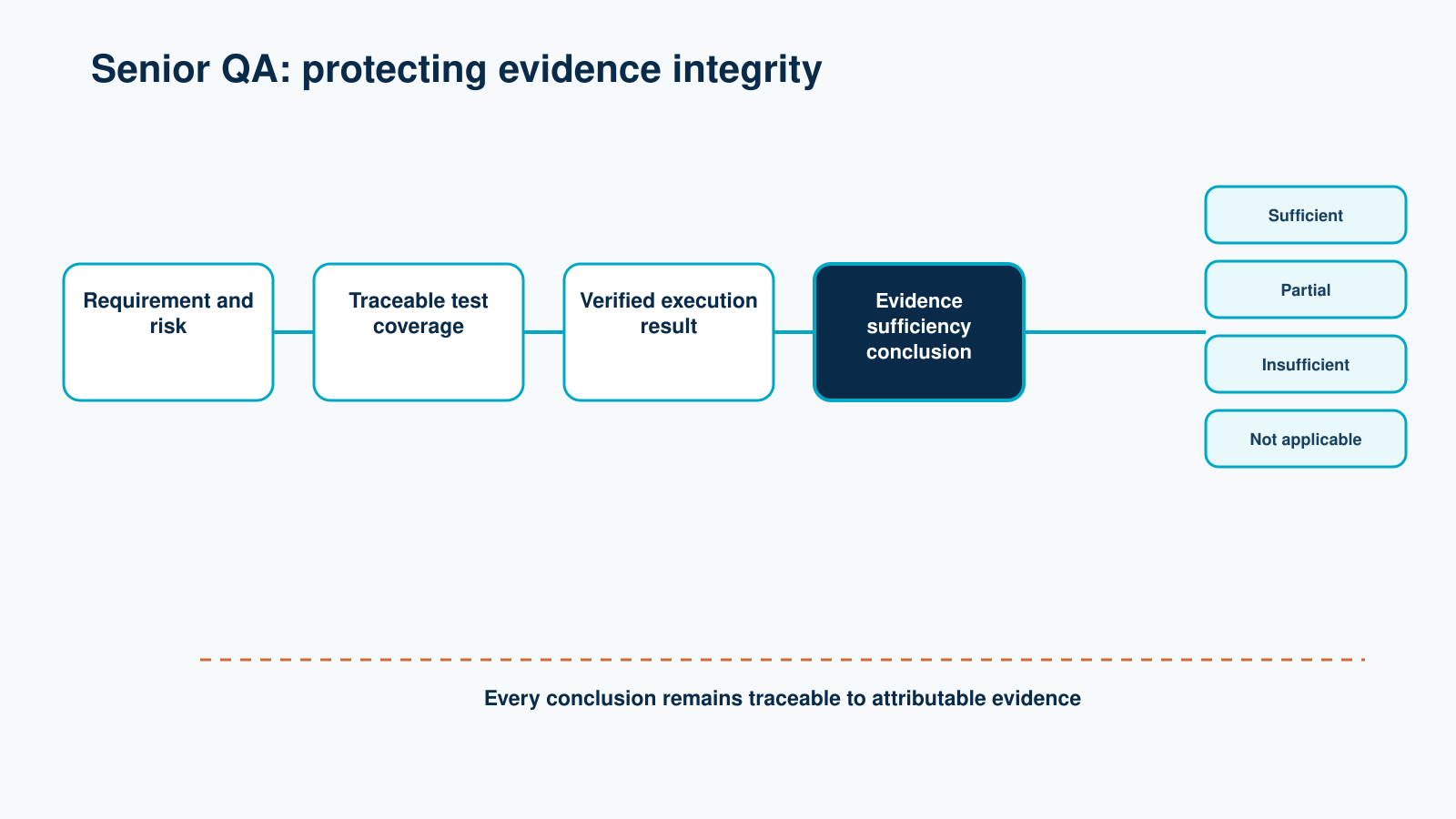
What Senior QA examines
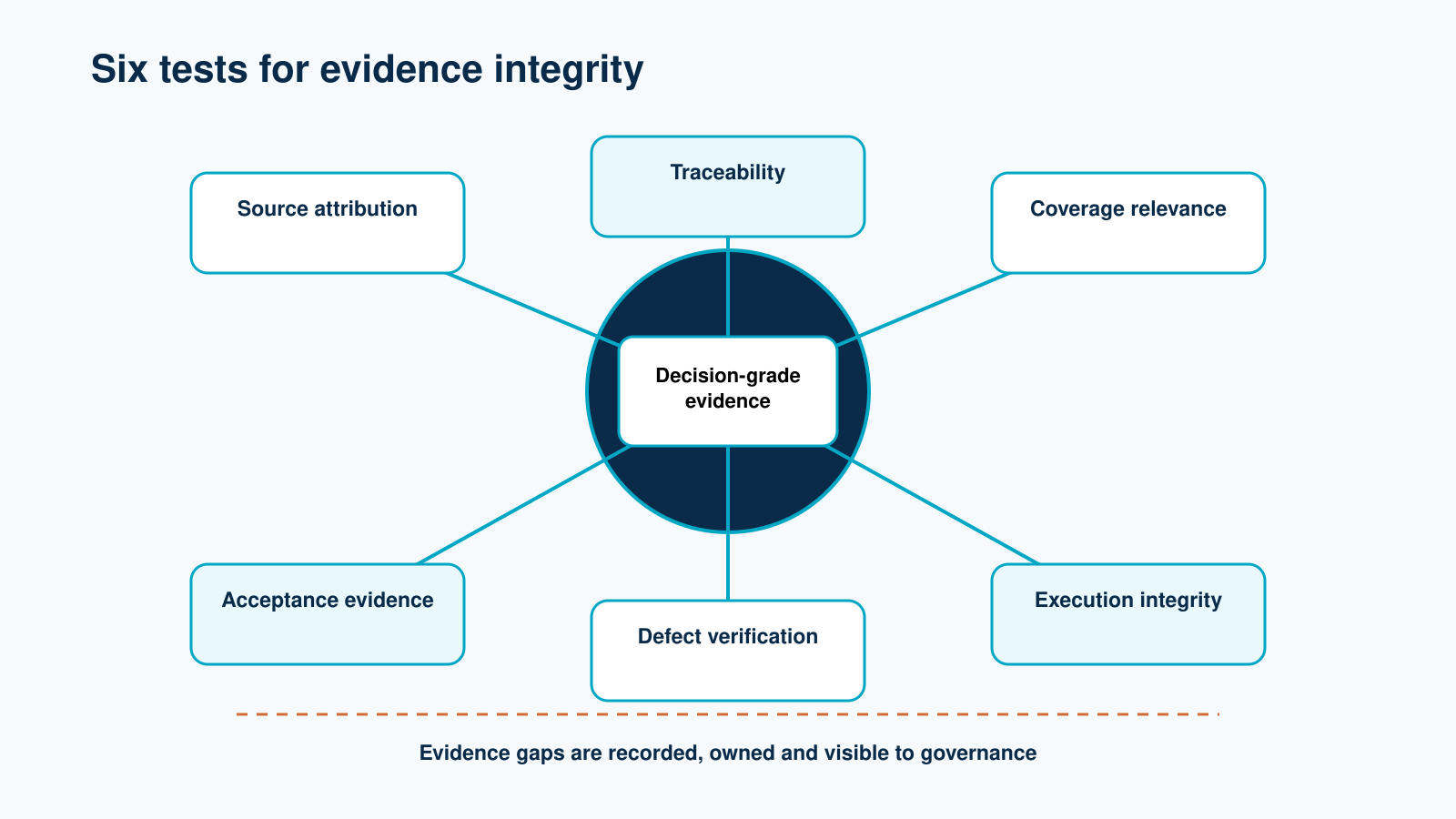
Test basis and traceability
Senior QA checks whether testing is anchored to approved business requirements, process designs, architecture decisions, acceptance criteria, regulatory obligations and material delivery risks. Traceability must show more than the existence of a link. It must demonstrate that the correct obligation has been interpreted, tested at the appropriate level and supported by an inspectable result.
Coverage and risk concentration
Headline execution percentages conceal where exposure is concentrated. The practitioner examines coverage across critical processes, user roles, integrations, reports, batch activity, permissions, error handling, data variants and non-functional concerns. Missing coverage is assessed by consequence, not averaged away within a large test count.
Test data and environments
A technically correct test can still provide weak evidence if its data or environment is unrepresentative. Senior QA tests whether data reflects real volumes, boundary conditions, security classifications, role combinations and migration states. Environment differences, unavailable interfaces, stubs and configuration departures must be visible in the assurance position rather than hidden in execution notes.
Execution records and result integrity
The practitioner samples execution records to determine whether the stated outcome is supported by reproducible evidence. This includes checking timestamps, versions, expected results, actual results, attachments, retest records and the treatment of blocked or incomplete tests. A pass without adequate evidence is an assertion, not a control.
Defects, recurrence and residual exposure
Defects are considered as evidence about the system and the delivery process. Senior QA looks beyond open counts to severity, ageing, recurrence, clustering, rejection rates, root cause, regression effectiveness and business consequence. Closure status alone does not demonstrate that the underlying exposure has been removed.
Acceptance and decision conditions
Where evidence is incomplete, the practitioner defines what must be corrected, what can be accepted with conditions and what should prevent progression. Conditions require named owners, due dates, verification evidence and an explicit consequence if they are not met. Unresolved uncertainty must not be converted into confidence through optimistic wording.
This detailed examination supports Enigma’s Quality and Test Assurance capability and the wider Independent Delivery Assurance model. The governing method is explained in How We Assure.
How the discipline works with other practitioners
Senior QA supplies detailed evidential findings into a multidisciplinary assurance opinion. It does not operate as an isolated testing function or a catalogue of individual contractors.
- Head of Test converts detailed quality findings into an overall quality confidence position and governance recommendation.
- Programme Directors connect quality exposure to programme viability, executive accountability and strategic consequence.
- Programme Managers test whether remediation, dependencies, resources and decision conditions are executable within the integrated plan.
- Scrum Masters examine whether incomplete work, impediments and quality debt are visible within delivery flow.
- Technical Architects interpret integration, resilience, security, performance and operability evidence against the intended technical design.
Independence boundary
A practitioner must not provide independent assurance over testing, quality controls or evidence that they directly designed, managed or executed. If a Senior QA practitioner has contributed to delivery, that area must be excluded from their assurance scope or reviewed by a separate practitioner with an independent reporting route.
This boundary is governed by Enigma’s assurance approach and Independence and Conflict Standard, which apply the conflict controls required for an assurance opinion.
Typical assurance outputs
- traceability and coverage assessment;
- test evidence sample and integrity findings;
- test data and environment representativeness review;
- defect exposure and recurrence analysis;
- phase entry or exit evidence assessment;
- documented evidence gaps, assumptions and limitations;
- prioritised remediation conditions with ownership and verification criteria;
- input to quality confidence ratings and programme board decisions;
- follow-up verification that corrective actions have produced adequate evidence.
What the client should expect
The client should receive a clear distinction between evidence that has been demonstrated, evidence that is incomplete and claims that remain unsupported. Findings must be specific enough to act upon and strong enough to withstand supplier challenge, internal scrutiny and later governance review.
Resource route: Quality Evidence Sufficiency Checklist. Link withheld until the resource is created, its final filename is confirmed and download availability is verified.
To discuss a defined assurance decision, use Enigma’s contact page.