
Agile activity is not evidence of delivery confidence. Sprints, ceremonies, velocity and backlogs can create an appearance of control while outcomes, dependencies, quality and release readiness remain uncertain. Enigma’s Scrum Master assurance capability tests whether agile delivery evidence can support the decisions required by the client.
This anonymous practitioner profile represents a senior Scrum Master discipline informed by recurring conditions observed across public and private-sector technology delivery. It does not represent a claimed individual biography, employer history, qualification or named engagement. Enigma sits on the client’s side of the table. The Scrum Master contributes an independent agile-delivery perspective within a multidisciplinary assurance team. This is not a contractor profile or an offer to run ceremonies for a supplier. It explains the control questions the discipline can test for accountable client governance without taking ownership of the delivery being assured.
The buyer concern
Agile delivery can make work visible, but the language of agile can also obscure the evidence a client needs. A supplier may report stable velocity without showing whether the highest-risk outcomes are being completed. A backlog may be well maintained while critical dependencies sit elsewhere. Sprint goals may be achieved while technical debt, defects, data readiness and operational acceptance accumulate beyond the team boundary.
The programme board does not need another description of ceremonies. It needs to know whether delivery is producing usable increments, whether forecasts are credible, whether impediments are being resolved and whether evidence supports the next commitment or release decision.
The control gap
Delivery teams and Scrum Masters should facilitate flow, remove impediments and improve ways of working. Product owners should prioritise value and accept outcomes. Programme management should coordinate dependencies and milestones. These responsibilities do not automatically provide an independent assessment of whether agile reporting is complete, comparable and decision-grade.
The gap appears when team-level measures are treated as proof of programme-level progress. Velocity is not a measure of value. Completed tickets are not evidence of operational readiness. A burn-up chart cannot by itself demonstrate quality, integration, migration or cutover confidence.
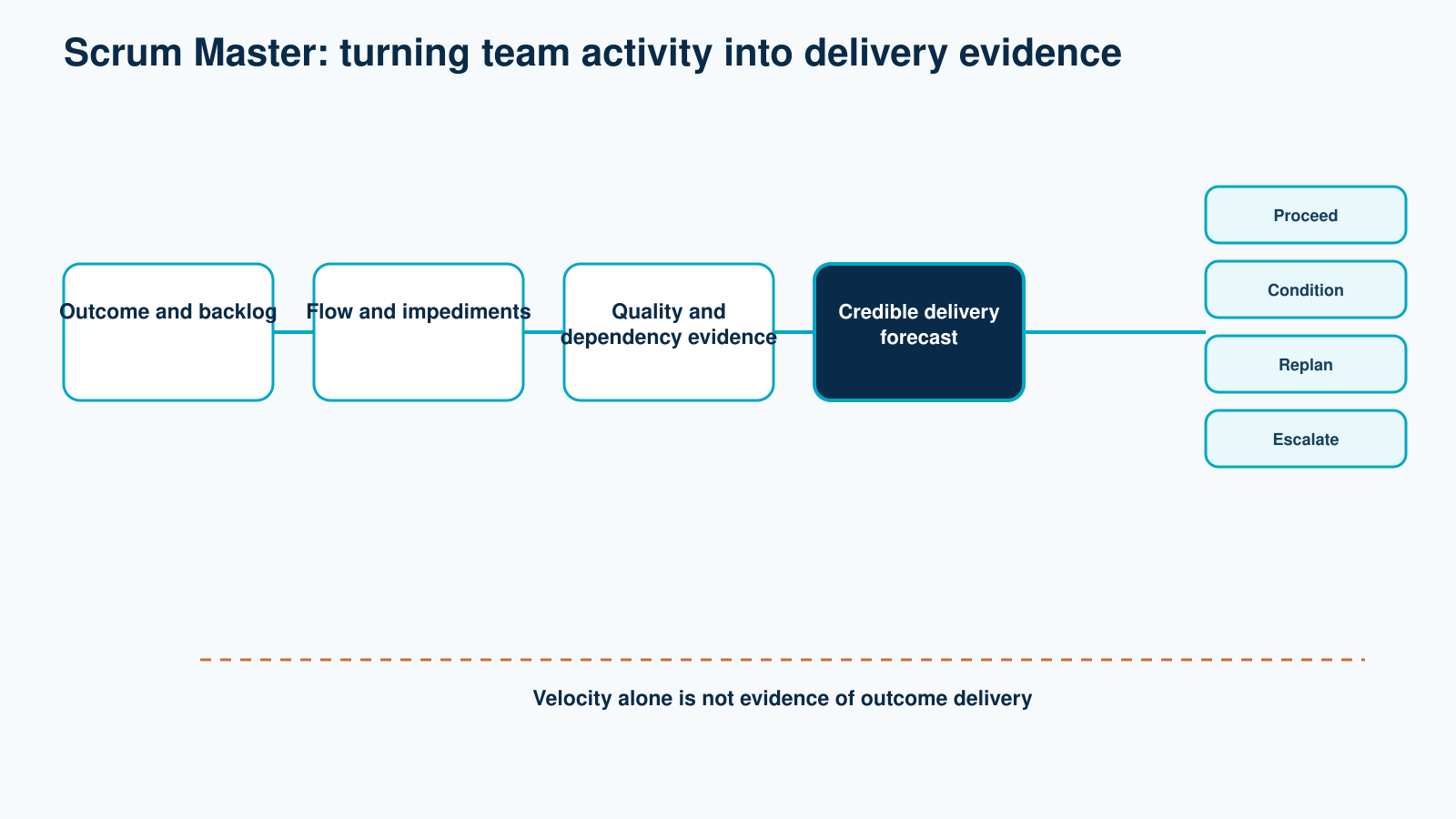
What the Scrum Master assurance perspective tests
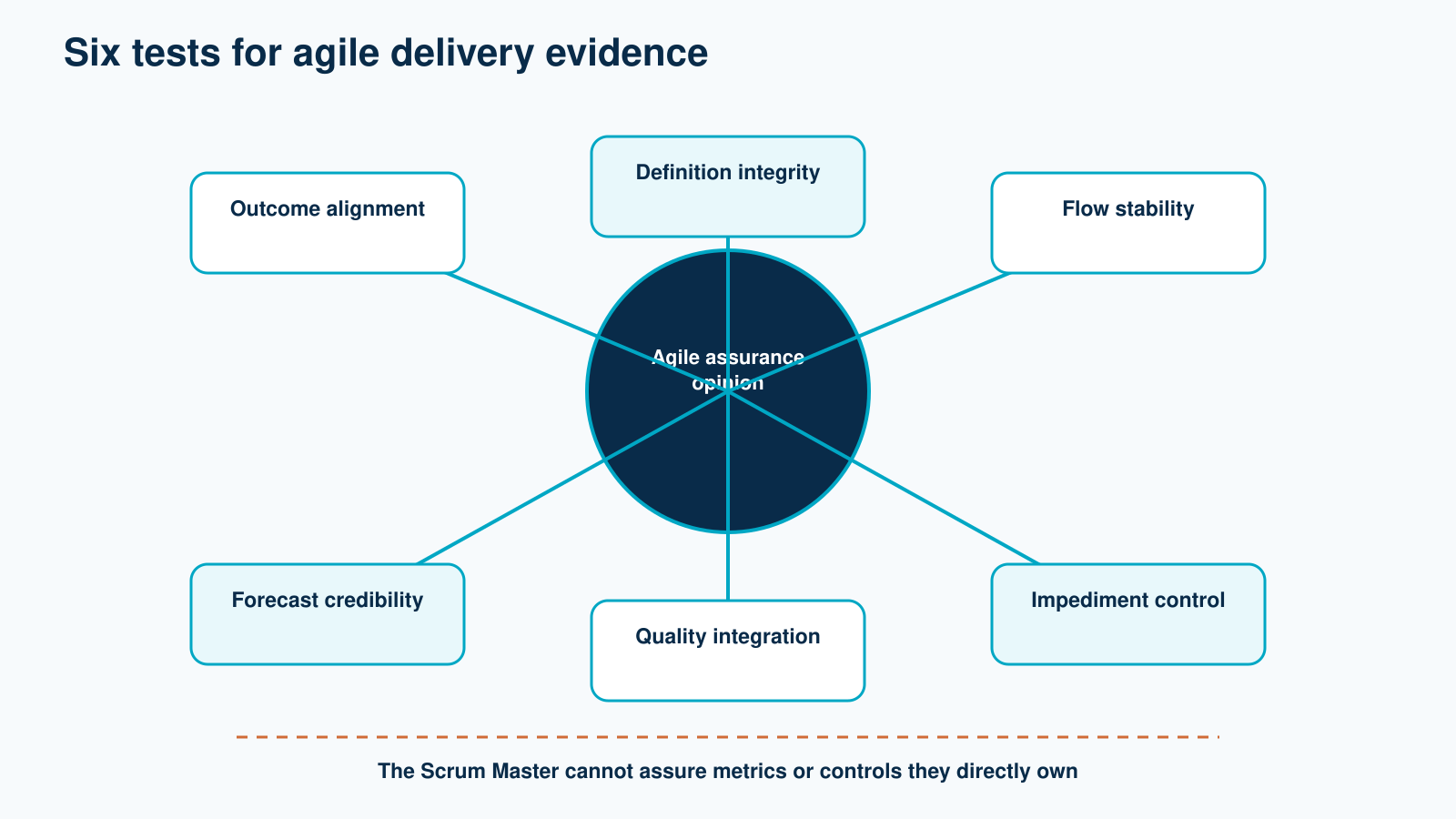
- Outcome alignment: whether sprint goals and backlog priorities connect to programme outcomes, risks and acceptance conditions.
- Definition integrity: whether ready, done, accepted and released have controlled meanings that are consistently applied.
- Flow evidence: whether throughput, ageing, work in progress and predictability are measured honestly and interpreted in context.
- Impediment control: whether material blockers have owners, escalation routes, consequences and evidence of resolution.
- Dependency control: whether cross-team, supplier, architecture, environment, data and business dependencies are visible in the forecast.
- Quality integration: whether testing, defects, technical debt and non-functional evidence are included in completion decisions.
- Forecast credibility: whether release forecasts reflect demonstrated capacity, remaining scope, uncertainty and known constraints.
- Governance connection: whether team evidence is translated into decisions and conditions at programme level.
How Enigma applies the discipline
The Scrum Master works within Enigma’s Evidence-to-Decision Assurance Model. The work begins with the decision, not with a generic agile maturity assessment.
- Frame the decision. Define what the client must decide, the relevant time horizon and the uncertainty that matters.
- Establish the delivery basis. Identify outcomes, release scope, acceptance criteria, Definition of Done, team boundaries and dependency assumptions.
- Request source evidence. Examine backlog history, sprint goals, flow data, impediments, decisions, defects, quality results and release evidence.
- Test reported claims. Compare dashboards and forecasts with demonstrated completion, ageing, rework, dependency movement and acceptance.
- Assess confidence. Distinguish supported claims from assumptions, incomplete evidence and unmanaged exposure.
- Report for action. Provide conclusions, conditions, owners and required closure evidence to the client governance body.
Evidence required
Evidence is proportionate to the decision. It can include outcome and release goals, product and sprint backlogs, acceptance criteria, Definition of Ready and Definition of Done, flow and ageing data, capacity assumptions, sprint results, demonstration records, defect and technical-debt records, impediment logs, dependency records, release forecasts, retrospectives, quality evidence and governance decisions.
Tool data is not accepted at face value. The review tests definitions, completeness, changes over time and whether the evidence reflects delivered and accepted outcomes. Where evidence is missing or contradictory, that uncertainty is made visible.
Outputs and decision value
- An executive conclusion on agile-delivery confidence for the decision in scope.
- An evidence-based view of forecast credibility, flow, impediments and dependencies.
- Findings linked to programme consequences rather than agile terminology alone.
- Conditions for proceeding, with accountable owners and closure evidence.
- Clear separation between team-level activity and programme-level completion.
- Targeted control improvements where evidence cannot yet support the claim.
The Scrum Master perspective is combined with programme, quality, architecture, migration and cutover disciplines where the decision crosses team boundaries. It supports Supplier Delivery Assurance, Programme Health Checks and Recovery and Quality and Test Assurance.
Independence and conflict control
A Scrum Master cannot independently assure the team, ceremonies, metrics or delivery controls they directly own. If a practitioner has facilitated the delivery being reviewed, that conflict must be declared and the independent conclusion assigned elsewhere. Advice to improve agile controls and independent assurance of those controls are kept separate through scope, personnel and reporting.
Useful resource and engagement route
Use the Independent Assurance Readiness Checklist to prepare the governance decision and evidence request. Further tools are available in Resources.