
Decision-specific assurance insight
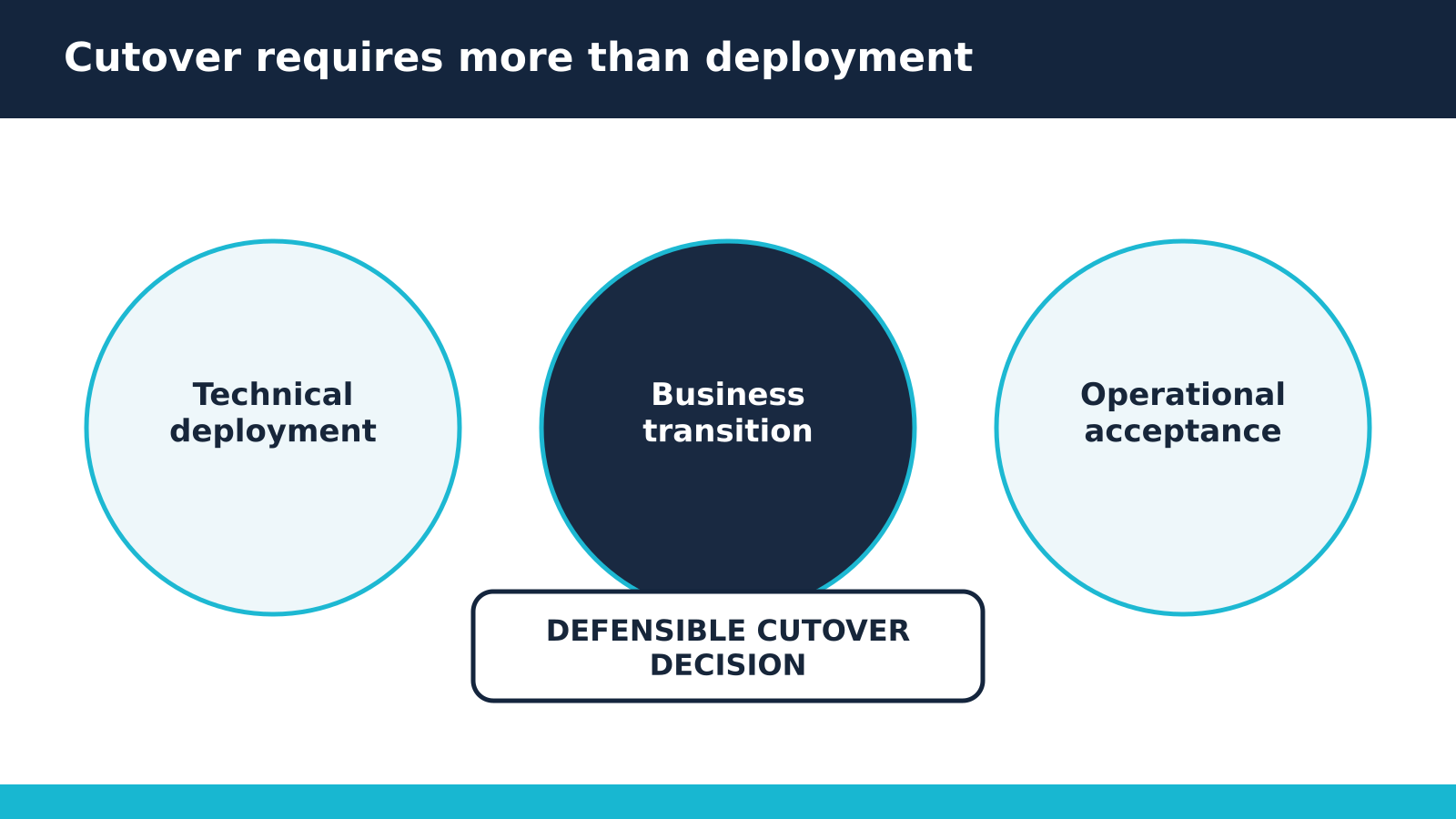
A programme can be technically ready to deploy and still be unfit to cut over.
Deployment readiness asks whether technology can be moved into production. Cutover readiness asks whether the organisation can move from one operating state to another without losing control of services, data, people, decisions or recovery options. Operational acceptance asks whether the receiving organisation is genuinely prepared to own what follows.
These are different questions. Treating them as one produces confident go-live decisions built on incomplete evidence.
The decision a programme board is actually making
A programme board is not merely approving a release. It is deciding whether the combined business, service, technical and supplier system is ready to absorb a controlled change.
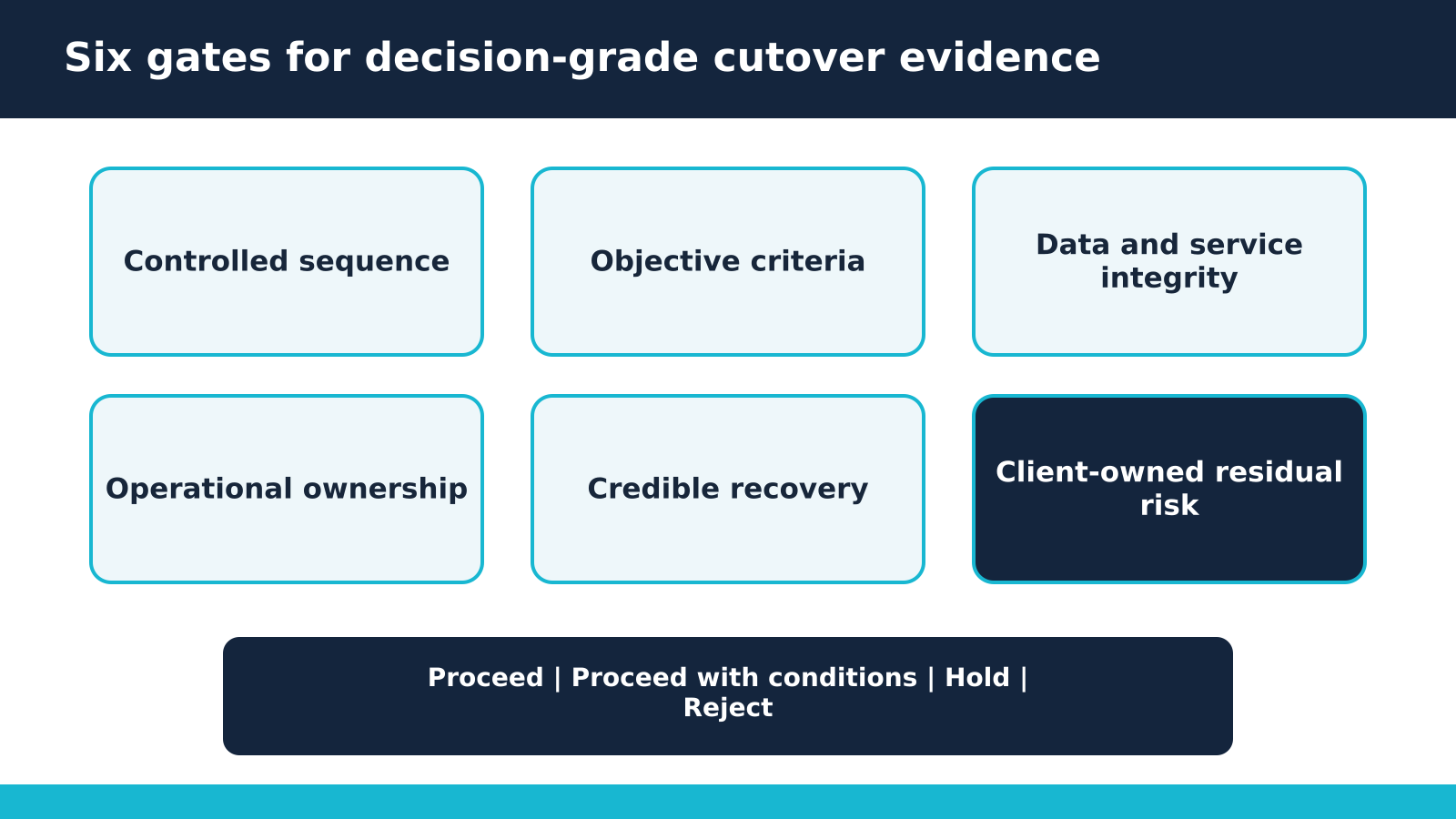
The decision should be one of four positions:
- Proceed: the evidence supports cutover and operational acceptance.
- Proceed with conditions: defined weaknesses remain, but their effect is understood, bounded and owned.
- Hold: evidence is incomplete or critical readiness conditions have not been met.
- Reject: the proposed cutover creates unacceptable service, data, operational or recovery risk.
A date, a completed deployment plan and a supplier recommendation do not constitute approval evidence.
Why cutover confidence is commonly overstated
Most cutover reporting is assembled by the teams responsible for delivering the change. Their knowledge is essential, but they are not independent of the outcome. Delivery pressure, sunk cost, contractual milestones and public commitments can all narrow the interpretation of readiness.
Typical failure patterns include:
- technical completion being presented as end-to-end readiness;
- open defects being accepted without testing the cumulative operational effect;
- migration reconciliation being treated as proof that data is fit for business use;
- support teams receiving documents without demonstrating practical readiness;
- manual workarounds being listed without capacity, duration or failure analysis;
- rollback being described as available without evidence that it remains executable;
- go-live criteria being changed late to accommodate the programme position;
- risks being accepted by people without the authority to own the consequences.
Enigma sits on the client’s side of the table. Our role is to test whether the evidence supports the client’s decision, not to protect a delivery narrative or manufacture confidence around a committed date.
Six tests for decision-grade cutover evidence
1. Scope and sequence are controlled
The cutover plan must identify every material activity, dependency, decision point, owner and timing constraint. It must distinguish preparation, execution, verification, business restart, operational handover and post-live stabilisation.
A long task list is not sufficient. The board needs evidence that the critical path, sequencing logic and cross-team dependencies have been tested.
2. Entry and exit criteria are evidence-based
Every cutover stage needs objective conditions for entry, completion, pause and rejection. Criteria must be agreed before delivery pressure peaks. Any exception must state the consequence, compensating control, accountable owner and expiry point.
Changing a criterion because it cannot be met is a governance decision, not an administrative update.
3. Data and service integrity are proven
Technical reconciliation alone does not prove that users can perform critical processes with migrated data. The evidence must cover completeness, accuracy, referential integrity, security, accessibility and business usability.
This should connect directly to Enigma’s published explanation of Data Migration and Cutover Assurance, while recognising that cutover assurance requires proof from the specific programme rather than generic confidence in a method.
4. The receiving operation can own the service
Operational acceptance requires more than completed training and handed-over documents. Support routes, monitoring, access, knowledge, service levels, supplier responsibilities, business continuity and incident ownership must work in practice.
The operating model should be tested against real scenarios. Enigma’s overview of IT service management responsibilities and value streams provides useful context, but programme acceptance must be based on current operational evidence.
5. Recovery remains credible at each decision point
Rollback is often asserted at programme level but becomes progressively less viable as data changes, interfaces restart and users begin operating. The board needs a time-bound view of recovery options at each stage, including the point after which restoration rather than rollback becomes the realistic response.
Recovery evidence must show technical feasibility, data consequences, decision authority, expected duration, communications and minimum service arrangements.
6. Residual risk is visible and owned by the client
Outstanding defects, workarounds, support constraints, migration exceptions and untested scenarios must be consolidated into a single decision view. Ownership cannot be left with the supplier where the client carries the service, financial, statutory or reputational consequence.
Acceptance must identify who owns each residual risk, why it is tolerable, what control remains in force and when the position will be reviewed.
What independent cutover assurance examines
A credible review triangulates evidence across the programme rather than accepting a single readiness pack. It should examine:
- the integrated cutover plan and critical path;
- technical deployment and environment readiness;
- data migration, reconciliation and business validation;
- test completion, defect exposure and acceptance evidence;
- business readiness, training and process transition;
- service management, support and supplier handover;
- security, access, monitoring and incident readiness;
- communications, command structure and decision rights;
- rollback, restoration and continuity arrangements;
- early-life support, exit criteria and stabilisation ownership.
Automated delivery controls can strengthen technical evidence. Enigma’s guide to CI/CD quality gates explains how objective controls can prevent unsuitable builds progressing. Those controls remain only one part of the wider cutover decision.
A multidisciplinary assurance judgement
Cutover is not owned by one discipline. Enigma brings programme leadership, programme management, quality assurance, agile delivery, technical architecture, data migration and cutover perspectives into one client-side assessment.
This is not a catalogue of contractors. It is a coordinated assurance capability applied to the decision and its evidence. No practitioner should assure delivery they directly own. Where a conflict exists, it must be declared and the judgement reassigned or independently reviewed.
What the board should receive
The output should be concise enough to support a decision and rigorous enough to remain useful after the meeting:
- a clear confidence rating with its evidence basis;
- readiness findings across all six tests;
- material gaps and contradictions;
- conditions that must be met before or during cutover;
- residual risks and accountable client owners;
- explicit proceed, proceed with conditions, hold or reject advice;
- the evidence that would change the judgement.
Practical resource
Cutover Readiness Decision Record
This resource should give SROs and programme boards a controlled place to record the evidence reviewed, readiness conditions, exceptions, recovery position, residual risks, decision authority and final outcome.
The question to resolve before go-live
Can the programme demonstrate that the organisation is ready to operate, recover and own the service after cutover, or can it only demonstrate that the supplier is ready to deploy?
If the answer depends mainly on delivery-owned reporting, the board does not yet have independent assurance. It has a recommendation from the people responsible for the outcome.
To discuss the decision and available evidence, use Enigma’s contact page.