
Decision-specific assurance insight
A programme board does not need more reporting. It needs evidence strong enough to support a decision.
Most technology programmes already produce dashboards, highlight reports, risk logs and supplier updates. The failure is rarely the absence of information. It is the untested assumption that the information is complete, current and independent of the people accountable for delivery.
When the same delivery structure owns the plan, defines the measures, selects the evidence and reports the conclusion, a green status may describe confidence inside the supplier team. It does not automatically establish confidence for the client.
The decision the board is actually making
Every status report asks the board to decide whether to continue, intervene, release funding, accept risk or approve a transition. Those decisions carry operational, financial and reputational consequences. The standard of evidence must therefore be proportionate to the consequence of being wrong.
- Is the reported milestone supported by completed and accepted outputs?
- Are dependencies evidenced, or merely described as manageable?
- Does forecast confidence reflect delivery performance and remaining uncertainty?
- Are testing, migration, security, operational readiness and cutover represented in the same view?
- Can a board member trace a material claim back to its source evidence?
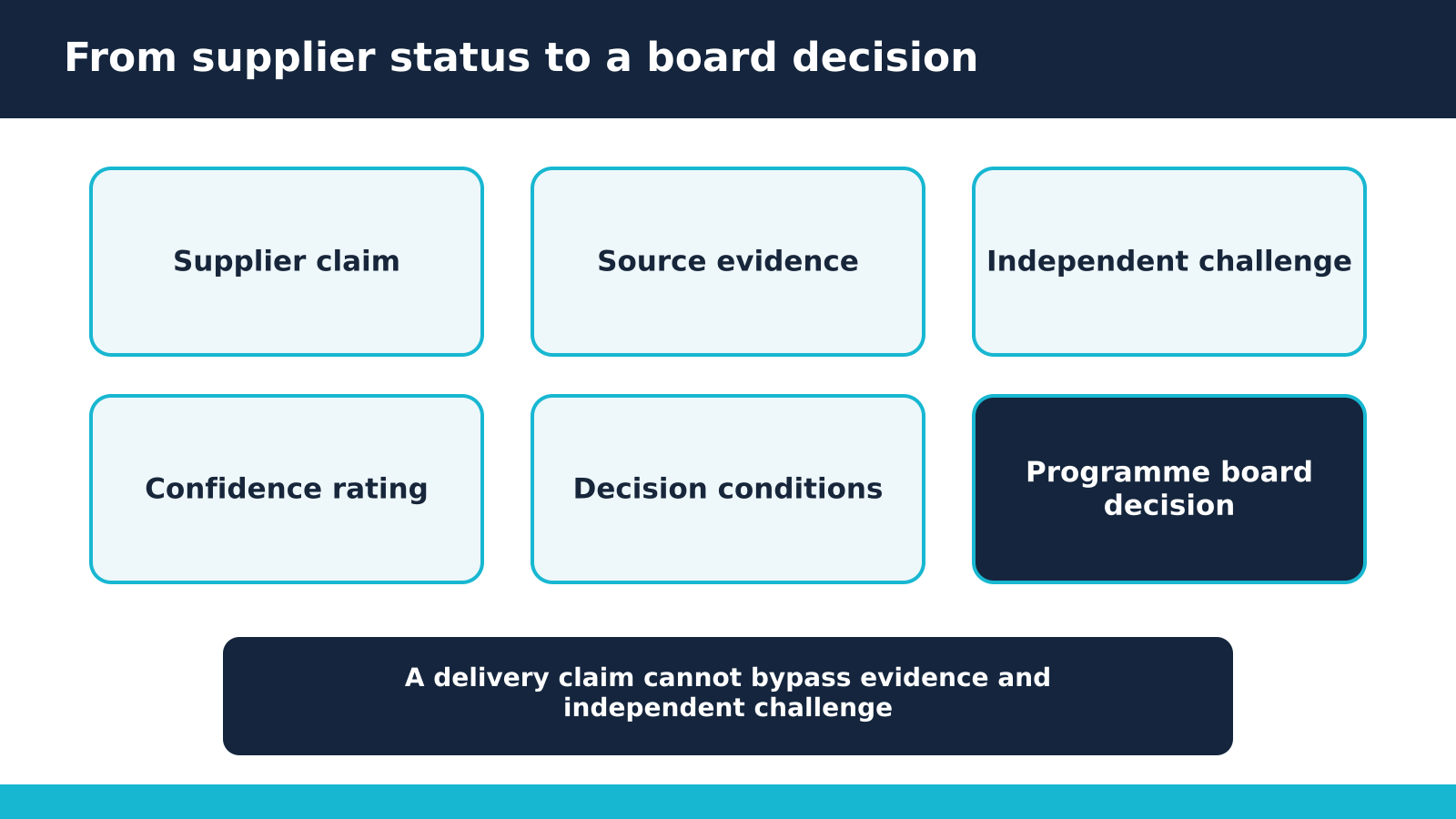
Why conventional status reporting fails
Conventional reporting compresses complex delivery conditions into a small number of indicators. Compression is necessary, but it removes context. A workstream may report green because activity is on schedule while acceptance criteria remain unclear. A migration may report amber because reconciliation is incomplete while the unresolved variance could make cutover unsafe. A supplier may report a recovery date without showing the capacity, dependencies and decision assumptions needed to achieve it.
The board sees the colour. It does not see the evidential weakness beneath it.
This is why Evidence Sufficiency Standard must be treated as a decision-control mechanism, not a communications exercise. Reporting is credible only when material claims are traceable, definitions are stable and challenge is independent of delivery ownership.
The minimum evidence test
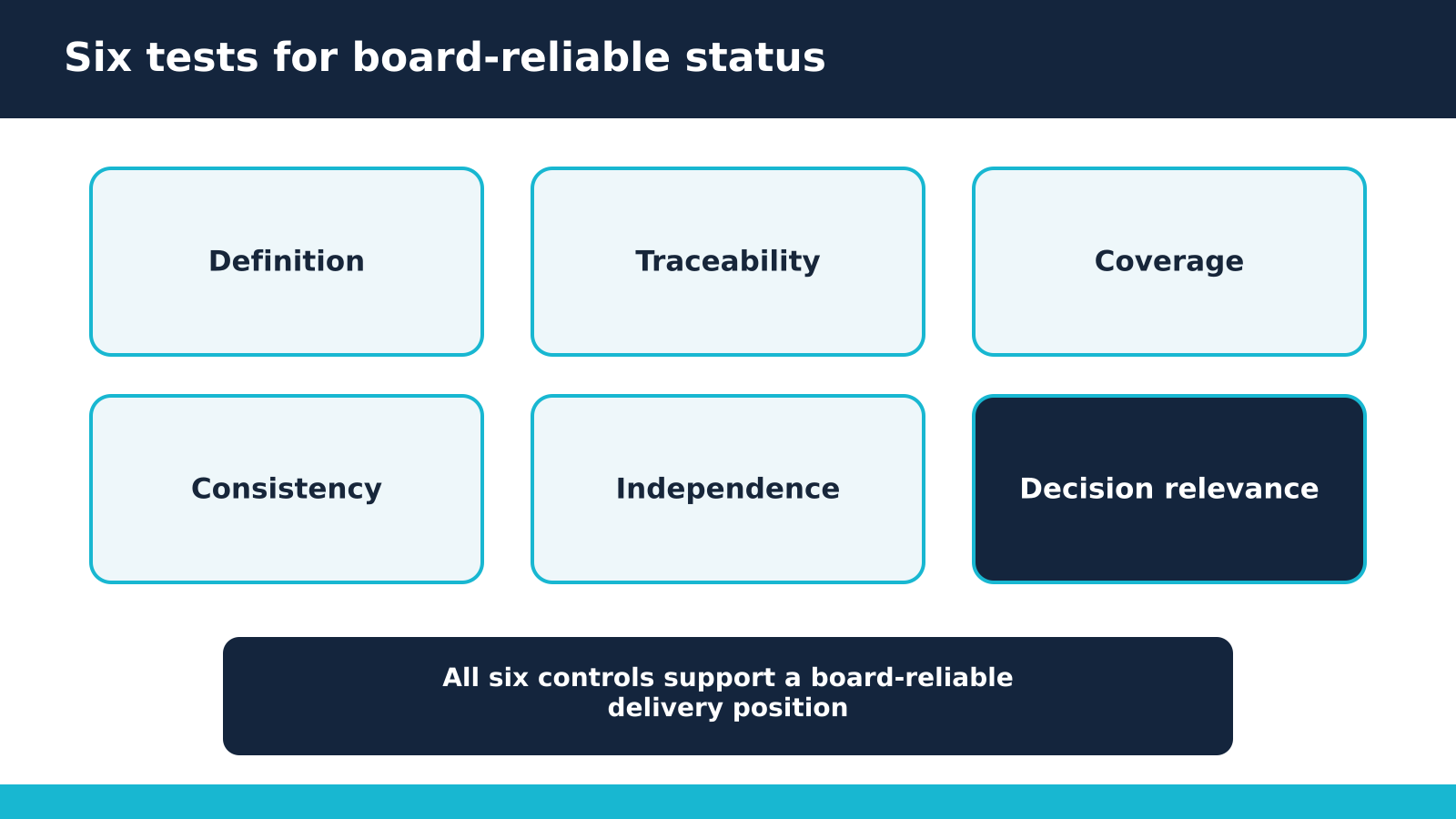
Before relying on a status, the board should require six tests:
- Definition: The measure has an agreed meaning, owner, threshold and reporting period.
- Traceability: The conclusion can be traced to current source evidence.
- Coverage: The evidence covers the whole material scope, not a convenient sample.
- Consistency: Related plans, risks, defects, finances and dependencies do not contradict the conclusion.
- Independence: The person assuring the conclusion does not directly own the delivery being assured.
- Decision relevance: The report explains what the evidence means for the decision now required.
What independent assurance changes
Independent assurance does not replace the programme team or duplicate supplier governance. It tests whether the board can reasonably rely on the delivery position presented to it. That requires access to evidence, the authority to challenge and freedom from incentives tied to the reported outcome.
Enigma sits on the client’s side of the table. Our multidisciplinary assurance view brings together programme direction, delivery management, quality engineering, architecture, agile practice, migration and cutover. These are not isolated contractor roles. They are different lenses applied to the same client decision.
The independence rule is absolute: nobody should assure delivery they directly own. Delivery expertise informs the review, but the assurance conclusion remains separate from delivery accountability. This principle is consistent with Enigma’s approach to working with clients and suppliers without surrendering the client’s need for an objective view.
Warning signs that board status is unreliable
- Green status depends on milestones that have moved without a recorded baseline decision.
- Percentages are reported without explaining the population, acceptance criteria or exclusions.
- Supplier narrative cannot be reconciled with defects, risks, dependencies or financial forecasts.
- Recovery dates are presented without resource, sequencing and dependency evidence.
- Testing reports activity completed rather than business risk retired.
- Migration confidence is asserted before reconciliation and operational proving are complete.
- The board receives conclusions but cannot access the evidence behind them.
- Challenges are answered by the same people whose performance is being assessed.
A useful resource for the next board cycle
Use the Programme Board Evidence Checklist before the next reporting cycle. For every material status claim, record the decision it supports, the source evidence, the evidence owner, the date tested, the reviewer, any contradiction and the resulting confidence rating.
The board-level conclusion
A delivery status is not reliable because it is concise, consistently formatted or presented with confidence. It is reliable when the underlying evidence is sufficient, the interpretation has survived challenge and the assurance is independent of delivery ownership.
If the board cannot trace a material claim, understand its limitations and identify who independently tested it, the report is not assurance. It is an assertion.
To discuss the decision and available evidence, use Enigma’s contact page.