
Anonymised composite case study
This case study combines recurring delivery patterns from complex data migrations. It does not identify a single client, supplier or programme.
An organisation preparing to replace a core operational platform had completed several migration rehearsals. Headline record counts reconciled, load jobs completed within the expected window and the supplier reported improving exception volumes. On that basis, migration was shown as ready for the final cutover decision.
The problem
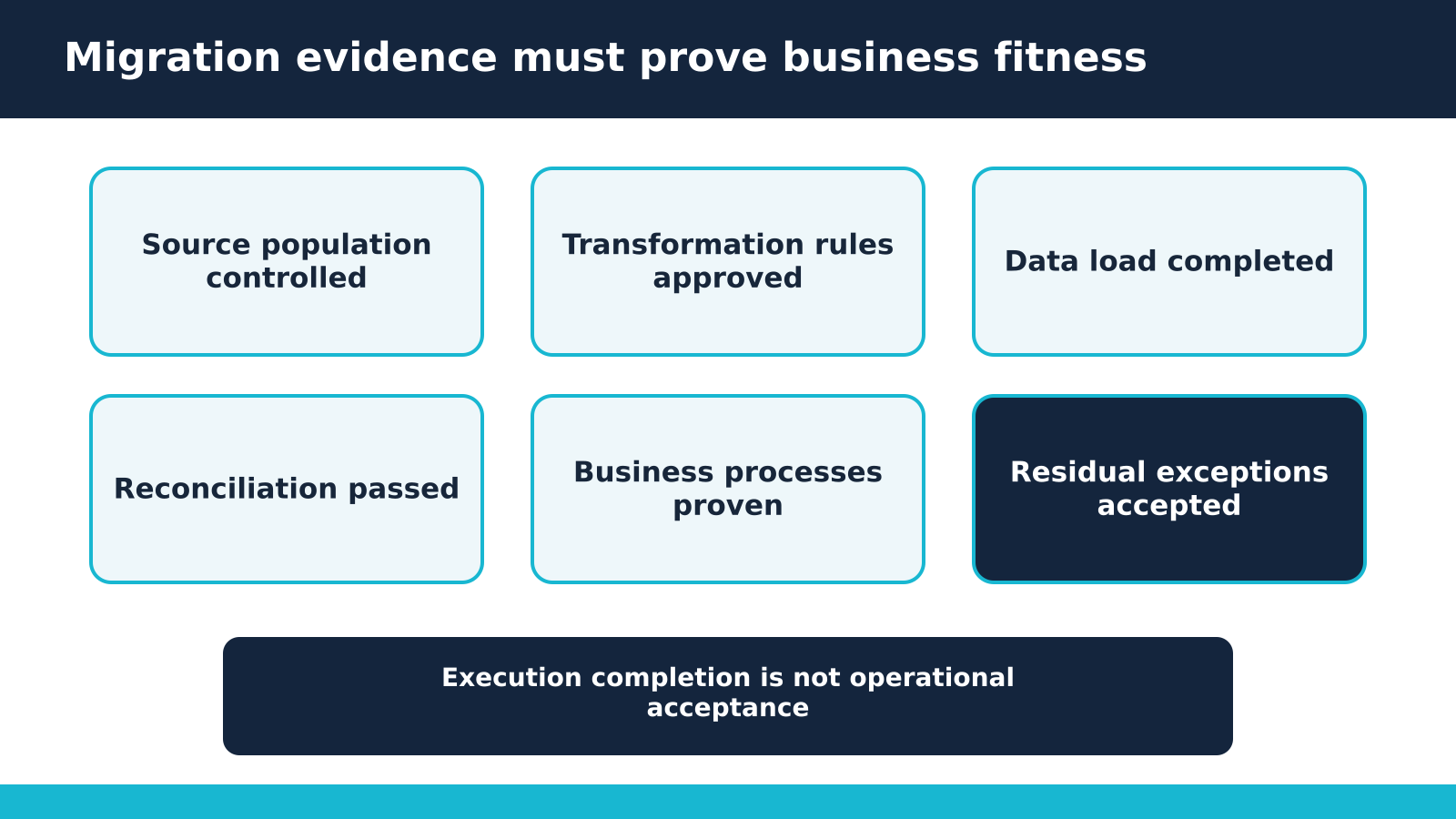
The reported position answered whether data had moved. It did not answer whether the migrated data was complete, accurate, meaningful and usable in the business processes that depended on it.
Migration acceptance was being inferred from technical execution. Business validation was limited, reconciliation was concentrated at total-count level and unresolved variances were carried as known issues without consistent impact assessment.
What the evidence showed
- Aggregate counts concealed differences between organisational units and record types.
- Transformation rules lacked complete traceability to approved business decisions.
- Default values produced technically valid records whose operational meaning had changed.
- Samples had been selected for convenience rather than risk, value, complexity or sensitivity.
- Some exceptions had no agreed disposition: correct, defer, accept or reject.
- The rehearsal did not fully reproduce cutover volumes, timings, staffing or recovery constraints.
- Rollback was described in the plan but had not been demonstrated against the complete sequence.
The migration process was functioning. The acceptance case was not.
The assurance intervention
Enigma separated technical completion from client acceptance and established six evidence tests: controlled population, transformation correctness, reconciliation depth, business usability, security and auditability, and cutover readiness.
The work included:
- Stratifying reconciliation by data domain, business unit, status and material value.
- Tracing transformation rules to named business owners and approved requirements.
- Selecting risk-based samples covering complex, sensitive, high-value and exceptional cases.
- Testing priority end-to-end processes using migrated data rather than inspecting records in isolation.
- Converting every material variance into a controlled disposition with an owner and consequence.
- Aligning the final rehearsal with the real cutover sequence, including decision points and recovery limits.
What changed
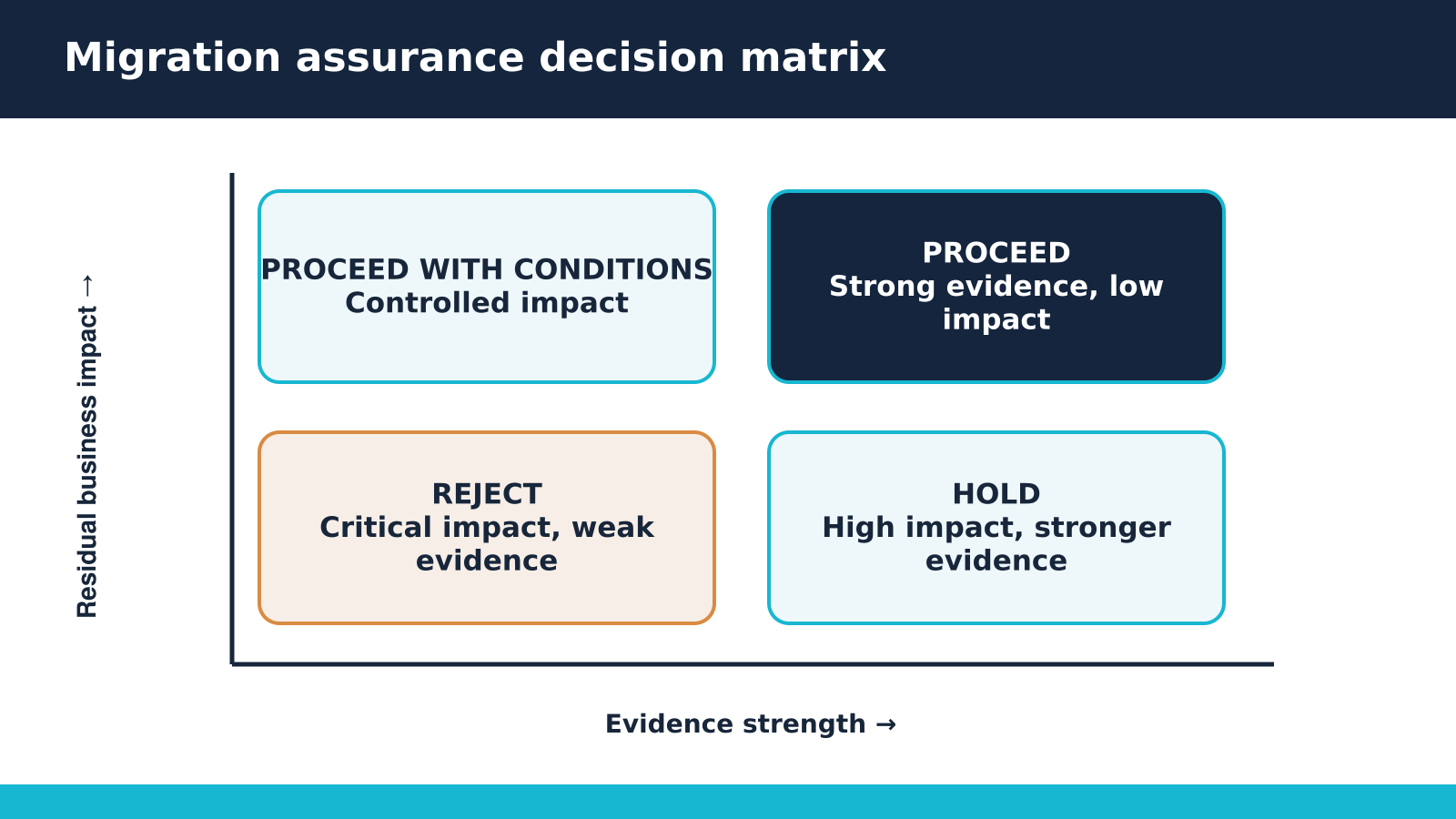
The board no longer received a single migration-complete percentage. It received an evidence-based view of what had reconciled, what remained uncertain, which business processes had been proven and what residual exposure would transfer into live operation.
The initial go-live assumption was replaced with a controlled decision. Critical evidence gaps had to be closed before progression. Lower-impact exceptions could proceed only with explicit conditions, operational controls and accountable owners.
This prevented user acceptance and early-life support from becoming informal cleansing phases. It also made the supplier’s obligations clearer by separating genuine delivery completion from client-owned risk acceptance.
The outcome
The intervention did not claim perfect data. It established a defensible boundary between acceptable residual imperfection and evidence gaps that threatened service operation. Cutover could then be considered against proven business usability, not merely successful technical loading.
The lesson is that reconciliation totals are necessary but weak. Migration assurance must follow data through transformation, relationship integrity, business use, operational ownership and recovery.
Enigma provides data migration and cutover assurance. Our role is to test whether the evidence supports the client’s decision, expose what remains unproven and prevent technical completion being mistaken for safe acceptance.