
Decision-specific assurance insight
A programme can remain busy, funded and heavily governed long after its original outcome has stopped being realistically achievable.
Delivery activity creates momentum. Teams complete work, suppliers submit reports, governance meetings continue and revised milestones appear. None of this proves that the programme still has a credible route to the intended business outcome.
The board-level question is not whether work is continuing. It is whether the remaining outcome is achievable within an explicit envelope of time, cost, scope, quality and operational risk.
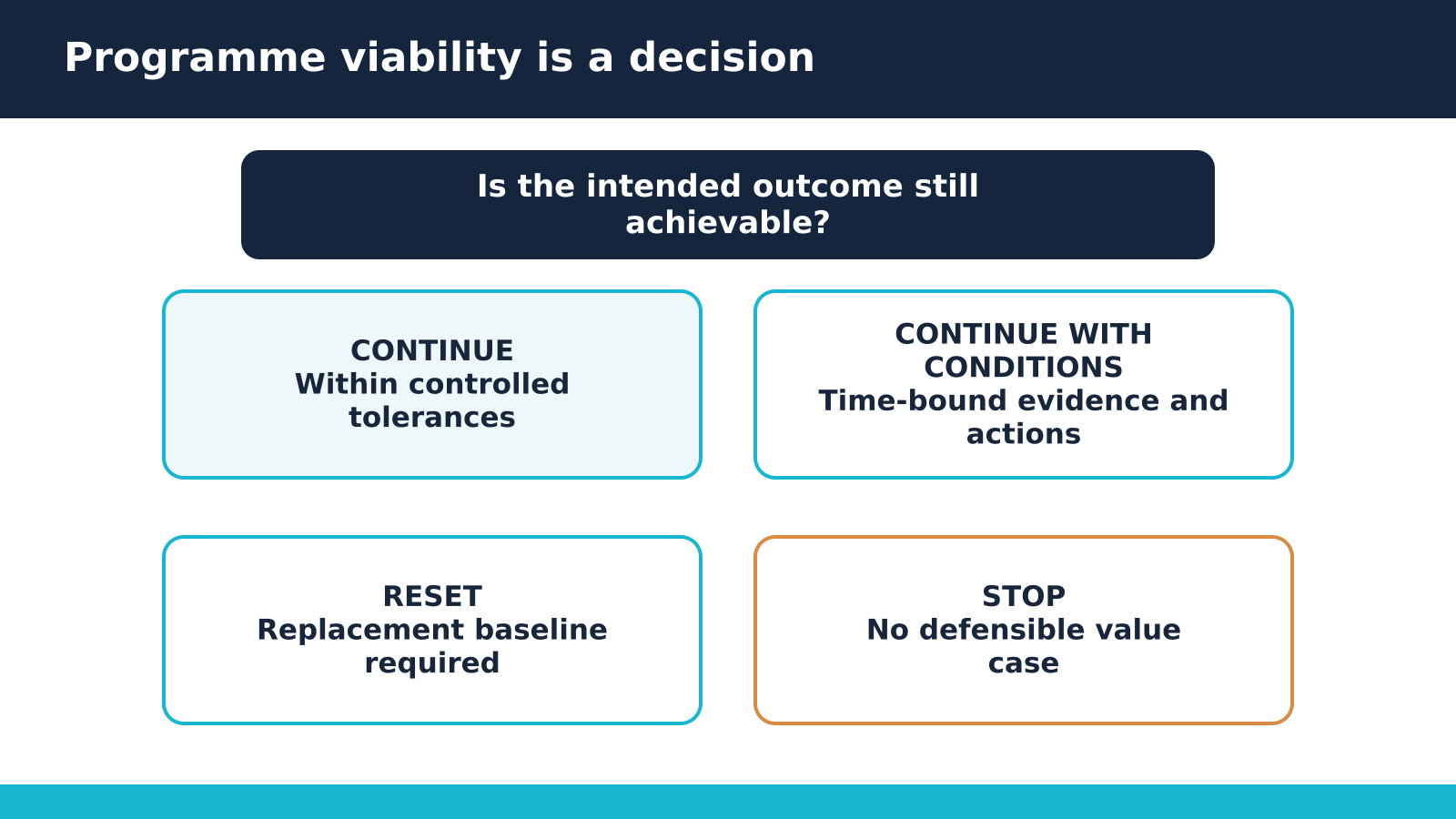
Viability is a decision, not a status colour
A viable programme has a defensible connection between the outcome still required and the capability still available to deliver it. That connection must survive scrutiny across the business case, scope, plan, supplier obligations, architecture, quality, migration, cutover and operational readiness.
A programme may report progress and still be non-viable because the remaining scope no longer fits the approved funding, the critical path depends on unproven assumptions, the solution cannot meet material non-functional requirements or the organisation cannot safely absorb the change.
- Continue: The intended outcome remains achievable within controlled tolerances.
- Continue with conditions: Viability depends on specific actions, evidence or decisions with named owners and dates.
- Reset: The outcome may remain valuable, but the current baseline, delivery model or scope is no longer credible.
- Stop: Further expenditure cannot be justified against the achievable outcome and residual exposure.
The six viability tests
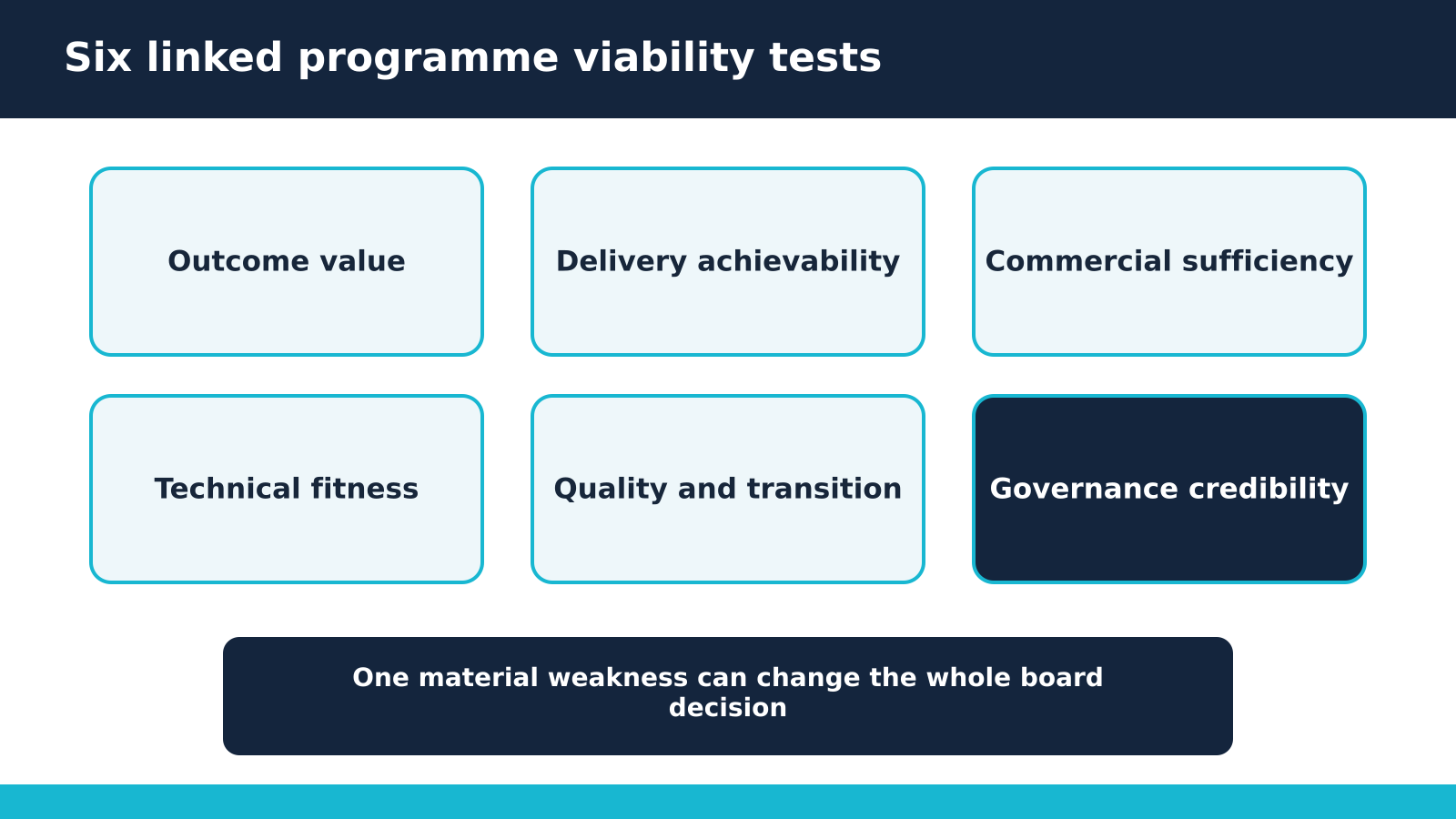
A programme board should require six linked tests before approving further commitment:
- Outcome value: The remaining outcome still solves a material business or public-service need, and the benefits have not been eroded by delay, scope loss or changed conditions.
- Delivery achievability: The integrated plan is based on evidenced capacity, realistic sequencing, controlled dependencies and current performance.
- Commercial sufficiency: Funding, supplier obligations, change exposure and forecast cost support the remaining work without relying on unidentified contingency.
- Technical fitness: Architecture, integration, security, performance, resilience and supportability risks are understood and capable of resolution.
- Quality and transition readiness: Testing, data migration, cutover and operational readiness can retire the risks that matter before service acceptance.
- Governance credibility: Decision-makers receive traceable evidence, material exceptions are explicit and the assurance conclusion is independent of delivery ownership.
Weakness in one test does not automatically require closure. It does require the board to understand whether another constraint can absorb it. A scope reduction may restore cost and schedule viability but destroy the intended benefit. A delayed cutover may protect service continuity but invalidate a contractual or legislative deadline. Viability must be assessed as a system, not as six independent scores.
Warning signs that the programme is merely still running
- The business case is referenced but has not been recalculated against current cost, scope and delivery dates.
- Repeated re-baselines preserve the final date by compressing testing, migration or operational proving.
- Recovery plans describe activity without quantifying how the delivery trajectory will change.
- Supplier forecasts depend on unresolved decisions, resources or technical assumptions.
- Scope is removed without tracing the effect on benefits, controls or service outcomes.
- Quality evidence reports execution volumes while material business risks remain open.
- Dependencies are labelled external rather than owned and managed across the programme.
- The board is told that stopping would waste prior expenditure. Sunk cost is not evidence of future viability.
These symptoms should also be visible in disciplined Confidence Rating Model. If they are absent from the board pack, the reporting process is concealing the decision rather than supporting it.
What independent assurance changes
Delivery owners are usually invested in completing the current plan. Suppliers have contractual and commercial interests. Programme leaders have reputational exposure. None of those facts proves that their judgement is wrong, but each creates a reason for the client to require an independent conclusion.
Enigma sits on the client’s side of the table. We combine programme direction, delivery management, quality engineering, technical architecture, agile practice, data migration and cutover assurance into one viability assessment. These are not contractor profiles offered separately. They are the multidisciplinary lenses required to test a single client decision.
The independence control is fixed: nobody should assure delivery they directly own. Our client-side approach separates evidence gathering and expert challenge from the accountability for producing the delivery being assessed.
The minimum board output
A viability review should not end with a general health score. The board needs a decision record containing:
- the outcome and benefits that remain achievable;
- the current cost, time, scope and quality envelope;
- the evidence supporting each viability test;
- material uncertainties, contradictions and evidence gaps;
- the independent confidence rating and its basis;
- the recommended route: continue, continue with conditions, reset or stop;
- conditions, owners, due dates and closure evidence;
- the residual risk explicitly accepted by the accountable authority.
A practical resource for the decision
Use a Programme Viability Decision Record to force the evidence, assumptions, tolerances and consequences into one controlled board paper. It should prevent sunk cost, delivery activity or supplier confidence from being treated as substitutes for an achievable outcome.
The board-level conclusion
Continuing a programme is an active investment decision. It must be justified by the value and achievability of the remaining outcome, not by the money already spent, the effort already invested or the discomfort of stopping.
If the programme cannot demonstrate a credible route from its current position to an acceptable outcome, it is not viable because activity continues. It is merely still running.
To discuss the decision and available evidence, use Enigma’s contact page.